The best Hermes Agent alternatives solve different parts of the same problem. OpenClaw is worth comparing if you want to retain an open agent environment. Lindy is a candidate for connected business routines. Claude and ChatGPT Work suit people who want to delegate work inside a familiar assistant. Manus and Okou are candidates when the deliverable matters more than the agent's underlying configuration.
Before switching, separate what you need Hermes to remember from what you need it to do. Remembering a client's preferences, repeating an approved procedure and running that procedure unattended are different capabilities. A product that does one well has not automatically proved the others.
Disclosure: this guide is published by Okou, which is included below. Most entries are editorial assessments of official documentation and public pages. Hands-on execution was limited to an Okou staging account, with material delivery and follow-up failures described below. We did not benchmark memory accuracy across products.
Hermes Agent alternatives at a glance
All prices are published USD prices checked on November 19, 2026. They are starting points, not equal-workload cost estimates.
| Product | Best reason to shortlist it | Continuity or repeatability to examine | Main trade-off | Published price |
|---|---|---|---|---|
| Hermes Agent, the baseline | Keep an open, customizable agent with persistent context | Curated memory, reusable procedures and deployment choice | Configuration and maintenance remain part of ownership | Free software; Nous Portal Plus $20/month |
| OpenClaw | Keep control of a personal agent environment | Local setup, persistent context and messaging connections | You retain operational responsibility | Free software; models and infrastructure separate |
| Lindy | Repeat work across business tools | Workspace context, scheduled routines and approvals | Per-active-user billing and task credits | Team from $29.99/user/month |
| Claude | Develop and revise documents with an assistant | Relevant files and context in the Claude experience | Product boundaries, usage limits and rollout | Pro $20/month or $200/year |
| ChatGPT Work | Continue business tasks within ChatGPT Projects | Project context and cloud Work chats | Shared allowances and account permissions | Plus $20/month; eligible access required |
| Manus | Commission research or a finished project | Task inputs, project context and output revision | Credit budget and delivery review | Pro from $20/month |
| Okou | Turn business instructions into delegated work | Reusable workflows and inspectable runs | Our staging delivery and continuation checks were incomplete | Pro from $20/month |
Sources: Hermes, OpenClaw, Lindy, Claude, ChatGPT, Manus, Okou.
First, check whether you need to replace Hermes at all
Some alternatives articles describe Hermes as a terminal application that requires you to build and host everything yourself. The current official site offers a desktop app for macOS and Windows, a terminal route for Linux, and optional cloud hosting through Nous Portal. That changes the starting point for a non-technical buyer.
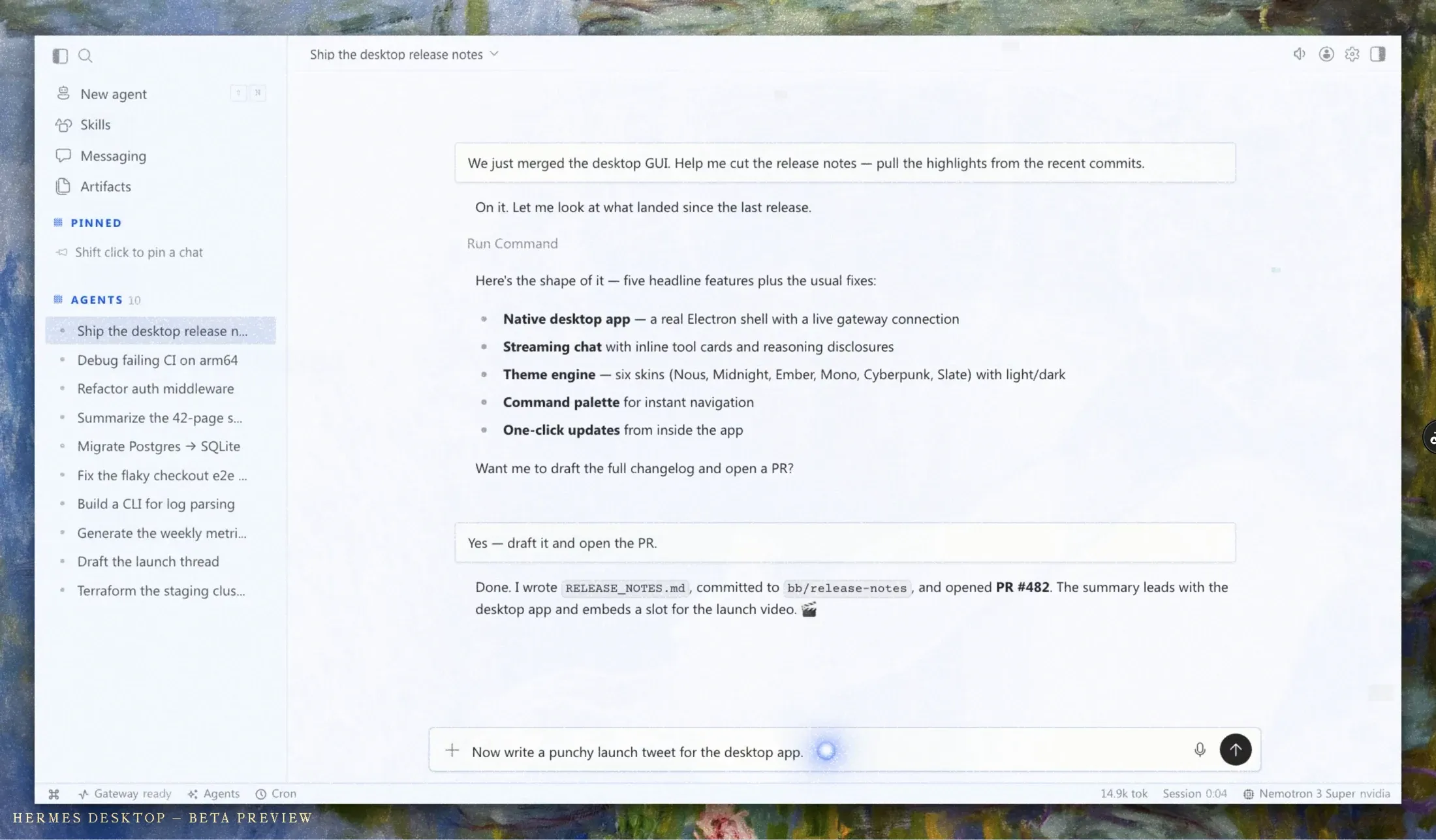
Official Hermes Desktop beta preview supplied by Nous Research, retrieved November 19, 2026. It illustrates the desktop task interface, not a task executed for this review.
The more useful question is whether Hermes's control is valuable to you. A consultant who wants explicit, inspectable working context may prefer it. An operations lead who wants a configured tool for a known business process may prefer a hosted application.
The memory documentation describes curated memory files, including general memory and user information, loaded into session context. Their size is bounded. A persistent memory system can save repetition, but it is still information that can be incomplete, stale or wrong. “Remembers you” should not be read as “never needs correction.”
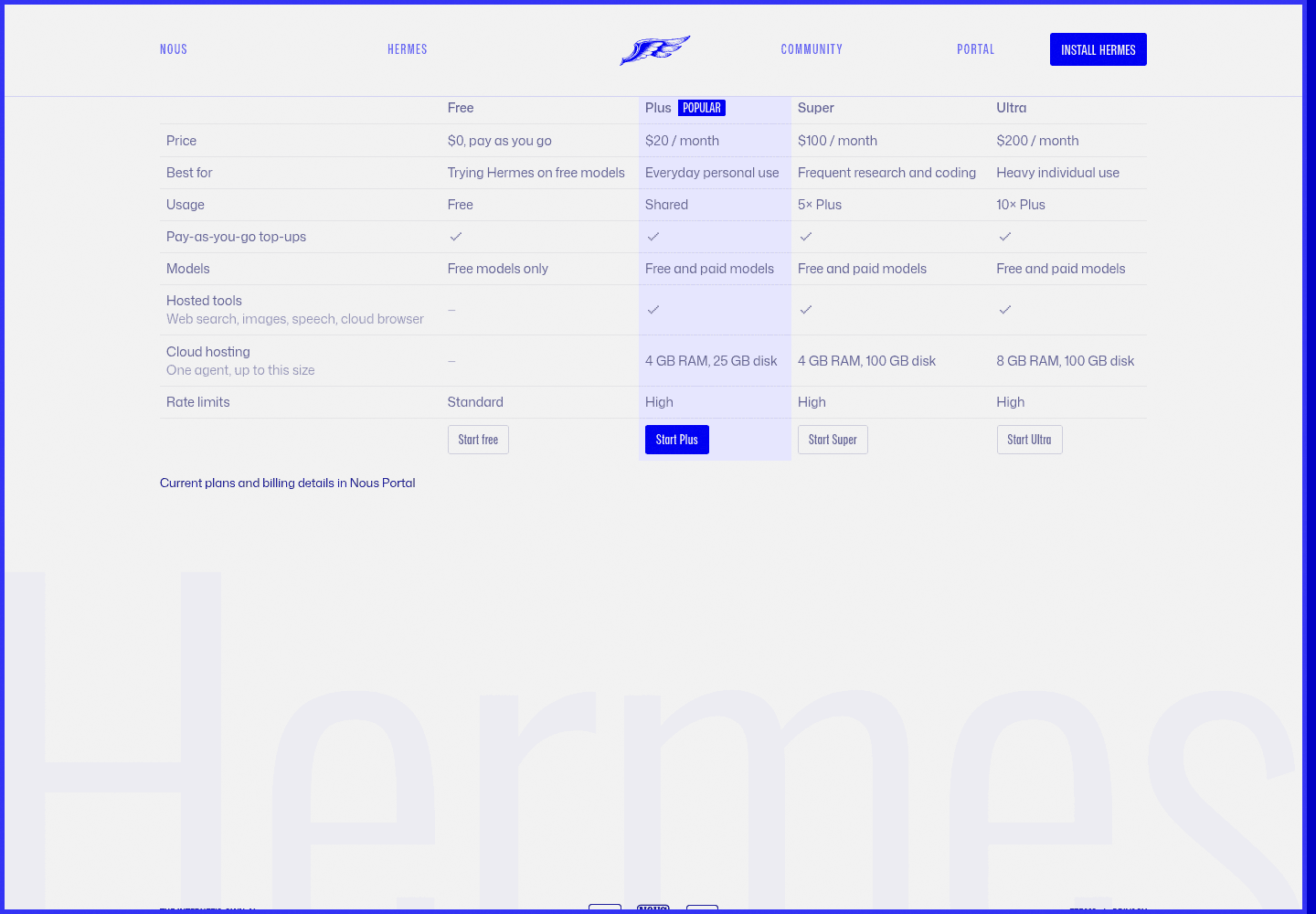
Hermes official plan table, captured November 19, 2026. Plus is shown at $20/month with one hosted agent within the listed limits. This is published pricing, not a tested cloud deployment. Source: Hermes official site.
If your only objection is managing a server, inspect the hosted option before rebuilding your working process elsewhere. If your objection is maintaining the process itself, a different product may be more suitable.
What should a Hermes replacement preserve?
Use a client reporting task to make the requirements concrete. The client wants USD figures, a short executive summary and an editable table. Last month's report is useful context, but this month's data must still be checked.
| Capability | What it should mean in practice | A useful acceptance check |
|---|---|---|
| Saved context | The assistant retains an explicitly approved preference or fact | Ask it to show and correct that context before relying on it |
| Reusable procedure | You can repeat the same steps with new inputs | Change one input and check that the result changes correctly |
| Controlled execution | You decide which actions need review | Ask for a draft and confirm that nothing is sent |
| Deliverable handoff | The intended recipient can use the result | Open the file, edit it and check its sharing access |
These checks are deliberately product-neutral. We designed the shared test protocol around them. We did not execute cross-session memory tests or enable scheduled work for this review.
1. OpenClaw: for keeping an open agent environment
OpenClaw is the most direct candidate here if you want a different personal-agent system while retaining control over how it runs. Its official site describes an assistant on your own devices, with desktop entry points and connections to messaging tools.
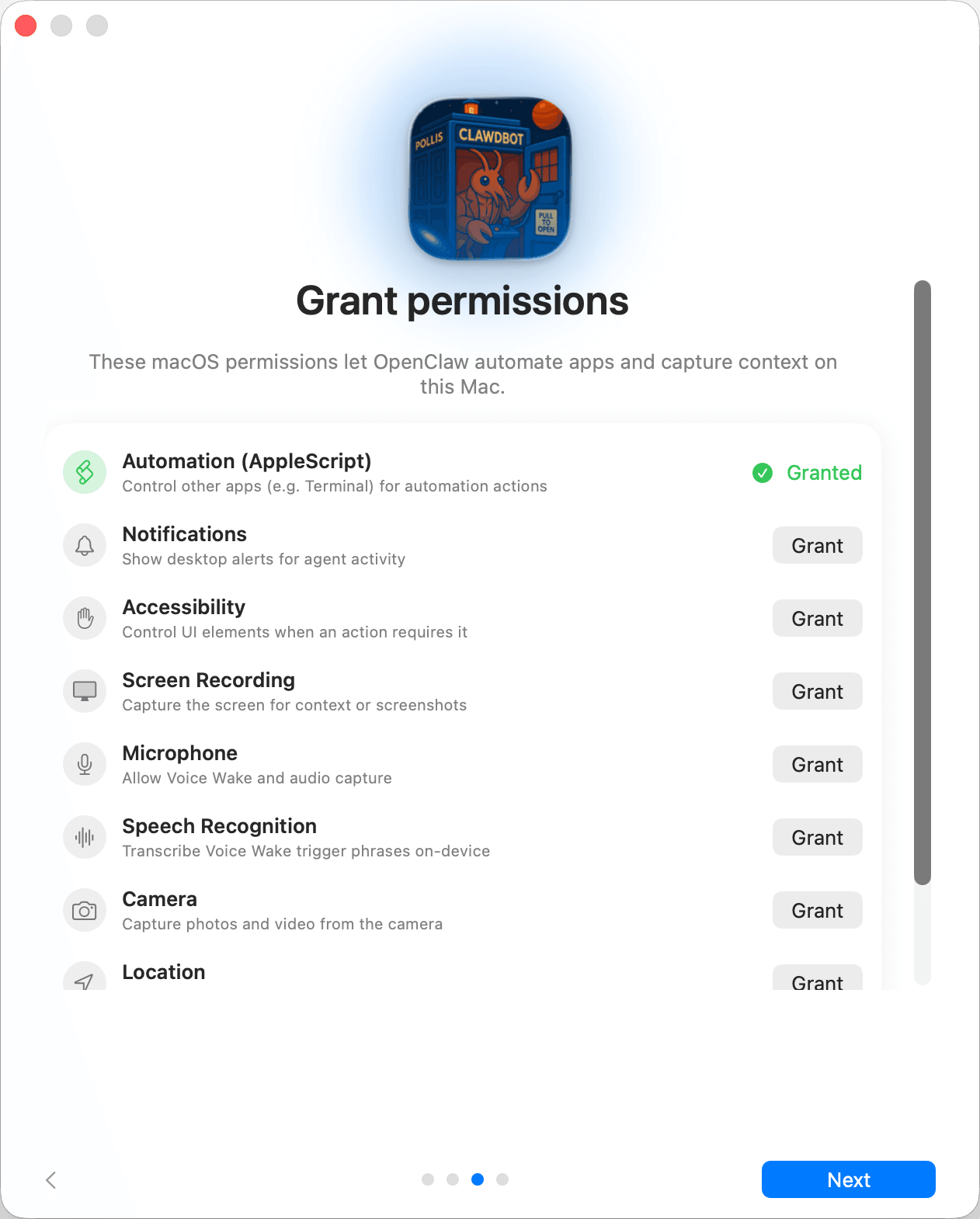
Official macOS onboarding screenshot from OpenClaw documentation, retrieved November 19, 2026. This is a setup interface, not a task we ran; the source retains its legacy Clawdbot app icon.
For a Hermes user, this is a change of environment, not an escape from configuration. You should expect to review your models, permissions, working files and recovery procedure again. The advantage is that you can continue making those decisions yourself.
Strengths: ownership of the setup, deployment flexibility and a product built around a persistent personal assistant. Desktop installers make the initial path more approachable than a terminal-only description suggests.
Limitations: we have not established a reverse import path that transfers a Hermes setup into OpenClaw. Hermes's documented OpenClaw importer works in the opposite direction; it is not proof of a bidirectional migration. We also did not test memory recall or backup restoration.
Choose it if you have a specific reason to prefer OpenClaw's environment and can maintain it. Skip it if your reason for leaving Hermes is that you do not want responsibility for an agent environment at all.
Price: free software, with model and infrastructure costs separate. Compare the running cost of your intended deployment, not just the license price.
2. Lindy: for recurring business work
Lindy is worth examining when “remember how I work” really means “follow our process across the tools we use.” Its live pricing page lists persistent workspace context, scheduled routines, meeting work, inbox tasks and built-in approvals.
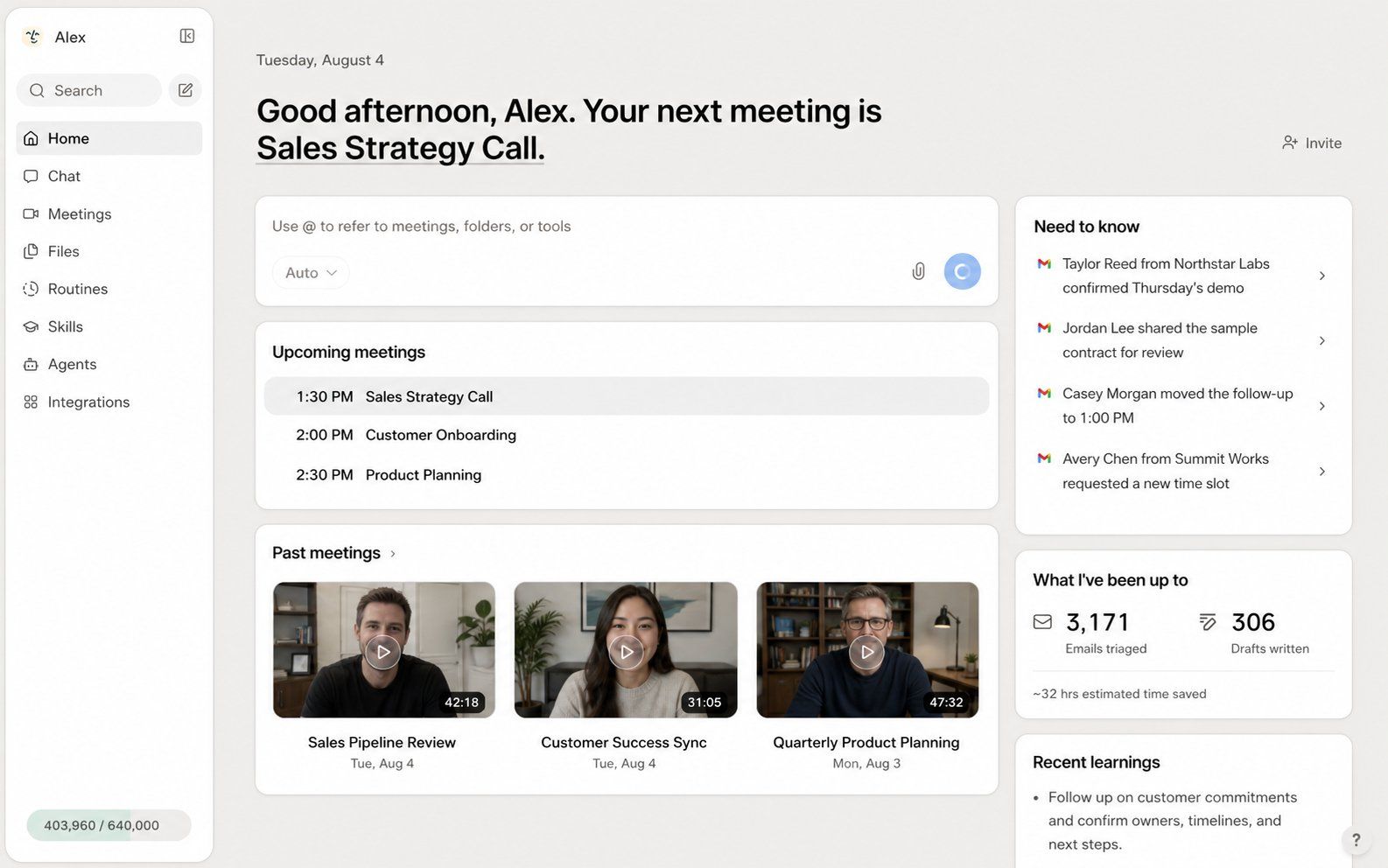
Official product-interface image from Lindy’s Home documentation, retrieved November 19, 2026. Meetings, messages and activity totals are vendor example data, not results measured in this review.
A consultancy might want a meeting brief assembled from connected information, followed by a draft follow-up. The useful trial is whether the right information is found, the draft is editable and the external action waits for the expected approval. We did not connect an inbox or run that process in Lindy.
Strengths: the public product is organized around business activities, and its billing page explains a shared workspace credit pool. That gives an operator concrete questions to ask about recurring workload and responsibility.
Limitations: published features do not prove that your particular connection or approval path works as expected. Every active workspace user is billed. A computer-use reference still names Pro and Max while the visible plan cards use Free, Team and Enterprise, so that entitlement needs confirmation.
Choose it if you can name a repeatable process and the connected systems involved. Skip it if you mainly want portable local memory files or unrestricted control of the runtime.
Price: Team from $29.99 per active user/month for 3,000 credits. Free trial credits are advertised as $50 in value and expire after seven days. Credit amounts should not be compared directly with another provider's credits.
3. Claude: for an ongoing document collaboration
If your Hermes use is mostly writing, analysis and document revision, examine Claude before committing to a different personal-agent platform. The Cowork product page describes delegated work with files and tools, and says these capabilities are becoming part of Claude across surfaces.
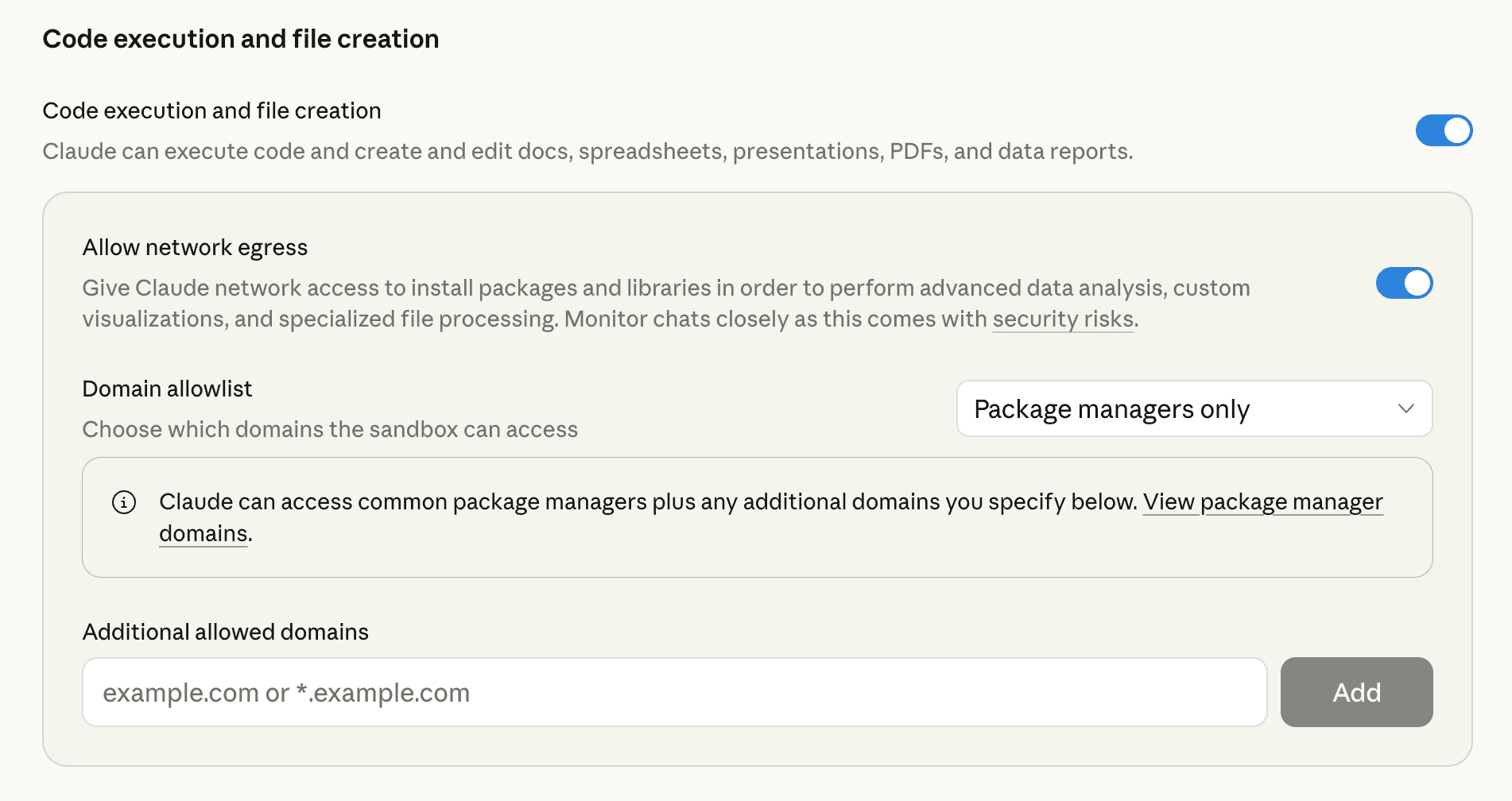
Official interface screenshot from Anthropic’s file creation and editing guide, retrieved November 19, 2026. It shows file-creation settings, not a completed task or a result from our testing.
For a business lead, continuity may mean that the assistant can work from the right brief and incorporate corrections while you develop a proposal. That is a narrower, more testable requirement than a claim about an agent “learning your business.”
Strengths: a document-centered use case can fit naturally inside an assistant you already use. The product page gives examples of turning materials into outputs rather than asking you to build an agent application first.
Limitations: the rollout shown on the public page is not proof of access in your account. Nor have we verified that a Hermes procedure or memory file can be imported with its behavior intact. Expect to restate the useful instructions and check them against a real document.
Choose it if your work involves reviewing and revising prose, tables or source material. Skip it if your essential requirement is an independently managed agent that preserves your existing runtime configuration.
Price: Pro is $20/month, or $200 billed annually. Usage limits apply. This is a documentation-based assessment, with no signed-in task or recall test.
4. ChatGPT Work: for continuity within ChatGPT Projects
ChatGPT Work is a useful candidate when your project materials already live in ChatGPT. The official Work guide says you can start a Work chat using a project's context and continue cloud Work chats across supported surfaces.
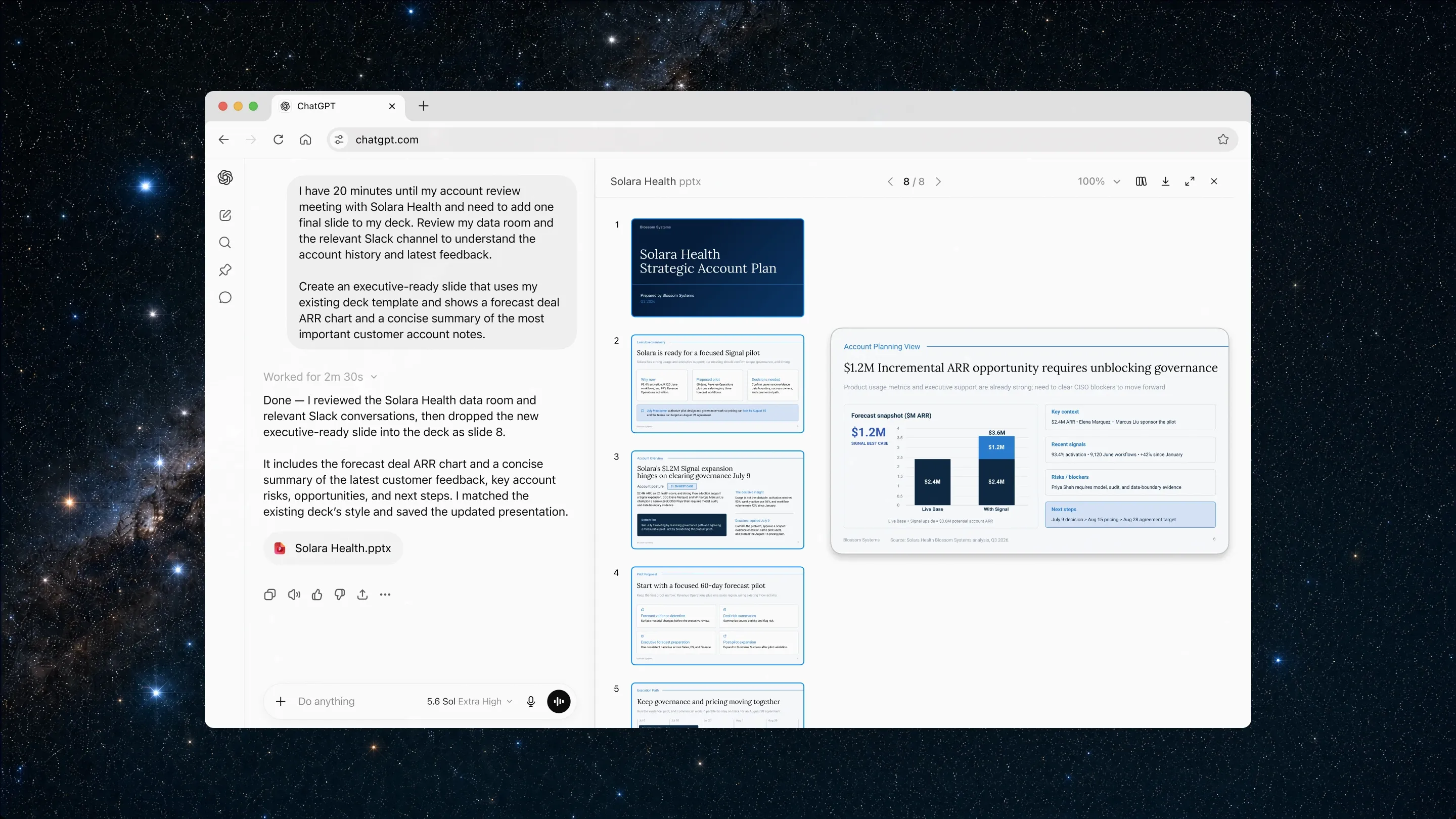
Official ChatGPT Work example from OpenAI’s July 9, 2026 announcement, retrieved November 19, 2026. The pictured account-plan deck is vendor demonstration material, not our test output.
For example, a founder can keep a source brief and task discussions in a project, then ask for a market comparison or presentation. That is documented project continuity. It is not evidence that Work automatically inherits or reproduces Hermes's memory system.
Strengths: a clear product path for research, analysis and business deliverables, with project context and connected-app permissions described in current documentation.
Limitations: Work availability depends on plan, seat and workspace settings. Work and Codex share a usage structure, with consumption varying by task and model. Old “ChatGPT agent” message limits should not be carried into a current Work comparison.
Choose it if you already organize work in ChatGPT and want to try delegation there. Skip it if you need portable runtime configuration or require a fixed, verified monthly capacity for a particular workload.
Price: Plus is $20/month; check Work eligibility and the allowance for your intended use. We did not access a signed-in Work account.
5. Manus: for work that ends in a finished project
Manus is a candidate when your Hermes tasks are mostly bounded assignments: research a market, prepare slides or create a website. Its official site presents a task composer and creation tools; the help center describes research and project features.
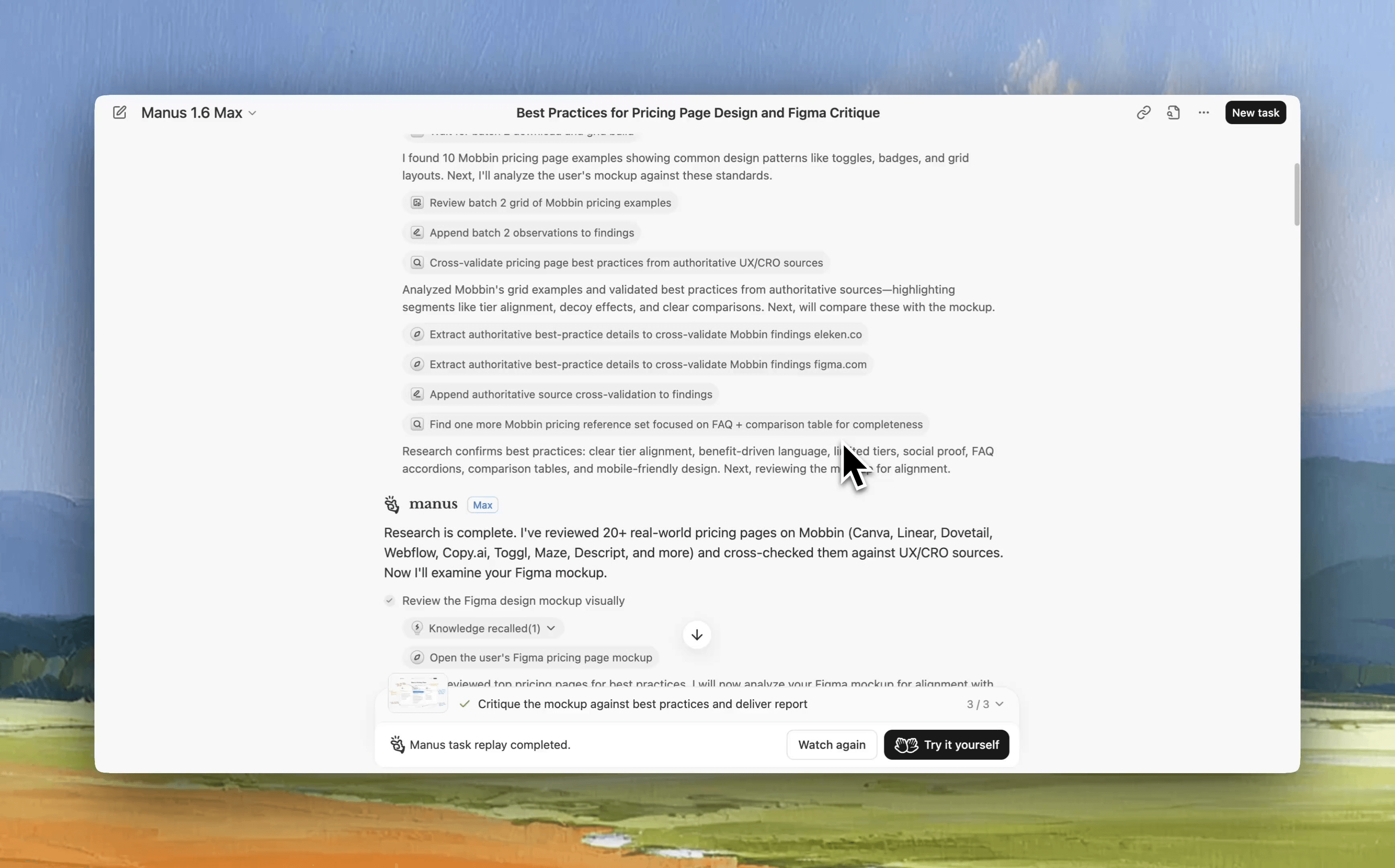
Frame at 00:05 from the official Manus Mobbin connector demo, retrieved November 19, 2026. The replay shows pricing-page research and a design critique in Manus 1.6 Max; this is an earlier vendor demo, not our hands-on test.
The replacement question is whether you can specify an output well enough to review it. A report is easier to accept when it has a short brief, explicit source requirements and a clear file format. Persistent personal context may be helpful, but it cannot replace those requirements.
Strengths: a hosted product centered on task delivery. It is worth a trial when you want to commission work without choosing an agent runtime.
Limitations: task credits and output quality need to be evaluated on your own work. We have not verified that Manus reproduces Hermes's learned procedures or transfers its memory. A deployed website can also incur separate WebDev running costs.
Choose it if you have a defined project and a clear review standard. Skip it if the main thing you want to preserve is a deeply customized Hermes environment.
Price: official help lists Pro from $20/month with 4,000 monthly credits; a $40 option includes 8,000. A Free plan is available. No paid task was tested.
6. Okou: for reusable business work, with limits in our test
Okou's product description focuses on delegated work, connected tools and workflows. For someone leaving Hermes, the potential value is making a useful process repeatable without maintaining the underlying agent environment.
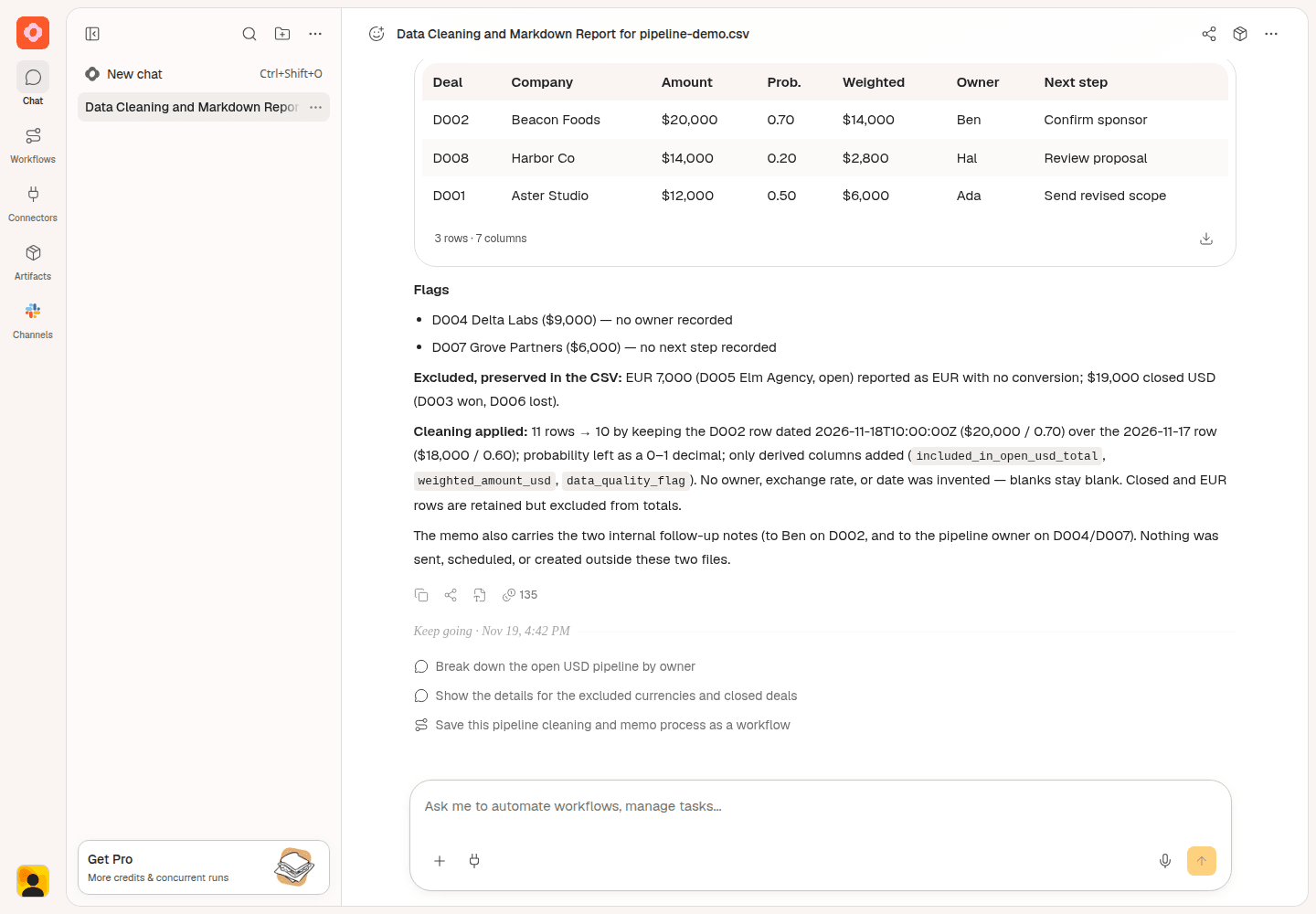
Our Okou staging test, captured November 19, 2026. Synthetic data; Free account; app version 0.1149.2; model displayed as Auto. This shows chat output, not successful file retrieval.
We tested that proposition only partially. In a Free staging account, Okou correctly summarized a synthetic sales pipeline after deduplication: $75,000 open USD and $39,550 probability-weighted USD. The result also flagged missing fields. But we could not open the returned CSV artifact, and a subsequent research-task attempt produced an “Agent not found” error. A manual changed-input follow-up did not produce a verifiable result during the review. After completing onboarding, a separate research attempt ended with model_provider_unavailable, so it did not establish research quality either.
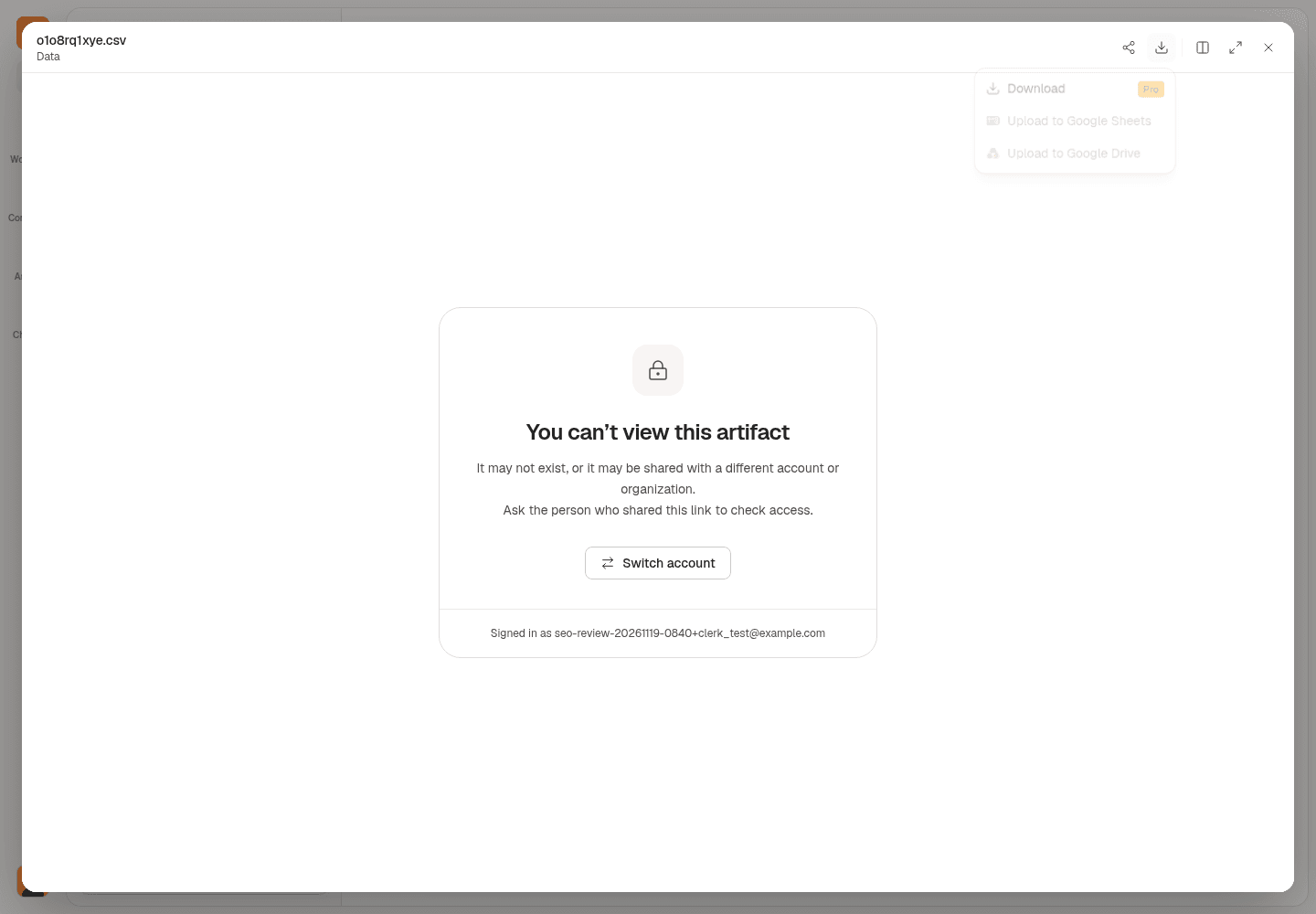
Our staging capture, November 19, 2026. The returned CSV link displayed an access failure. This does not establish the cause or the behavior of a paid production account. Source: Okou staging.
Strengths observed: the first task's visible arithmetic and exclusions matched our prepared answer. Work history and usage were visible in the chat.
Limitations observed: correct calculations did not establish file delivery, repeatability or cross-session memory. The test also needed a pasted CSV after the attachment failed to remain visible. The underlying model was not exposed beyond Auto, so this result cannot support a model-controlled comparison.
Choose it if you want to trial a business workflow with explicit acceptance criteria and inspect the handoff. Skip it if you need this review to establish dependable repetition or artifact access on the tested setup; it does not.
Price: Pro starts at $20/month; Team starts at $180/month including the platform fee and one starting member package. Free includes 1,000 credits valid for 30 days. No subscription was purchased for testing.
What recent Hermes users report
We selected original public X posts about concrete use and limitations. The sample is small, English-query-led and self-selected. Author relationships matter, and the visible counts below were collected on November 19, 2026.
| Original source | Report or short quotation | Context and visible engagement |
|---|---|---|
| Pablo, November 19 | Reported returning to a server-fleet status interface built with Hermes and a named model while away. | Non-official user/creator; 1 like, 227 views. A technical setup and self-reported outcome, not our test. |
| Nikki, November 19 | “My clients are on Slack and WhatsApp Business.” The post describes building a custom Hermes-based layer around client and team tools. | Builder with commercial interests; 2 likes, 127 views. This is not proof that stock Hermes includes that whole application. |
| HOPE., November 19 | Promoted a third-party memory-review procedure, including “verifying whether each memory is accurate”. | Extension maintainer promoting their own work; 7 likes, 310 views. Not independent evidence of a memory error rate. |
| Nous Research, November 9 | Official announcement promoting a model's availability in Hermes. | Official source; 807 likes, 57,862 views. An availability announcement, not a quality test. |
The reports support questions worth asking: how much of a useful setup did the user build, can stored context be inspected, and which model produced the result? They do not justify a claim that a given percentage of Hermes users are satisfied, or that one product has more reliable memory than another.
How to move your working process to another agent
Write down the behavior you want to preserve before moving any files. “Use a short executive summary, keep currencies separate and ask before sending” is easier to test than copying a large directory and hoping the new product interprets it the same way.
Keep approved preferences separate from temporary project facts. A client's reporting currency may be durable; last week's revenue is an input that should be refreshed. Review the material before giving it to a new assistant.
Then run one small task and change one input. If the output includes a file, open it and edit it. If the workflow will eventually run on a schedule, inspect how to pause it and review proposed external actions before enabling anything. We did not create schedules or write personal memory during this evaluation.
Do not assume the OpenClaw-to-Hermes migration guide proves portability in every direction. Even that documented route treats schedules, secrets and channel pairing separately. No universal Hermes export-to-every-assistant path was verified for this article.
FAQ
Is Hermes Agent only for technical users?
Its current desktop and hosted options make that description too broad. How approachable it feels still depends on the task, model, configuration and support available. We inspected the official options but did not complete Hermes onboarding or a business task ourselves.
Which Hermes alternative has the best memory?
This review cannot establish a winner. A useful memory comparison needs explicit saved facts, correction and deletion checks, new sessions and a defined pass condition. We did not run that experiment across these products. Compare inspectability and control before trusting a broad memory claim.
Can I keep Hermes and avoid managing a VPS?
The official site advertises desktop use and optional Nous Portal cloud hosting. Plus is listed at $20/month with one hosted agent within its published resource limits. Check current Portal billing and usage terms for your deployment.
What is the best free Hermes alternative?
OpenClaw has free software, but models and infrastructure can cost money. Hosted products may offer free access or trial credits with different restrictions. “Free” does not establish that your recurring workload or preferred output format is included.
Will my Hermes workflows migrate automatically?
We did not verify an automatic migration into the hosted products in this guide. Expect to reconnect accounts, restate procedures and test the behavior. Preserve useful instructions in ordinary documents so you can review them independently of a product.
Should I leave Hermes for a business-focused assistant?
Try one if maintaining the setup is crowding out the work you want done. Stay with Hermes if inspectable context, customization and deployment control are central to your needs. Our guide to agent product categories can help you separate those priorities.
To evaluate Okou, review the current plans and bring one small task with a checkable output. Include the file-opening and repeat-run checks that our staging test could not complete before making it part of a recurring process.