An AI agent is software you give a task to. It decides the steps, uses your tools to do them, and stops when the job is done or it gets stuck. Agentic AI is the broader word for AI that works this way. So the two terms are not rivals. "AI agent" names a thing. "Agentic" describes how much of the work the AI plans and does on its own.
Why does this matter? Because vendors use both words loosely, and the label rarely tells you what a product will actually do with your inbox, your CRM, or your customers. This guide explains where the words came from, how people use them today, and how to judge any tool by asking a few plain questions.
If these terms still feel abstract, start with an agent doing a job to see how goals, context, and tools fit together. Then follow the agentic working loop to understand why planning and acting independently are separate from being reliable or having permission to make changes.
AI agents vs agentic AI: the short version
| AI agent | Agentic AI | |
|---|---|---|
| What it is | A thing you can point to | A description, or a whole category |
| How people say it | "We use an AI agent to research new leads." | "This workflow is agentic." |
| How big | One system doing one kind of task | Anything from a simple AI-assisted process to several agents working together |
| What to ask | What job does it own, and what can it touch? | How many decisions does it make before a person checks the work? |
Nobody owns these terms. If an article gives you one "official" line between them, it is giving you one group's opinion.
Where the words came from
"Agent" is old. In their 1995 textbook Artificial Intelligence: A Modern Approach, Stuart Russell and Peter Norvig defined an agent as anything that senses its surroundings and acts on them. By that definition a thermostat counts. What is new is that today's AI models can read messy work material, like an angry customer email, and decide what to do about it.
"Agentic" is newer. In June 2024, Andrew Ng, founder of DeepLearning.AI, suggested a way to stop arguing about what "counts" as an agent. Treat it as a matter of degree, he wrote. "Unlike the noun 'agent,' the adjective 'agentic'" lets you describe systems that are a little agent-like or very agent-like.
He had used a good analogy a few months earlier. Asking an AI for an answer in one go is like asking someone to write an essay without ever pressing backspace. An agentic approach lets the AI outline, research, draft, check, and revise, the way a person would.
YouTube · Sequoia Capital
What's next for AI agentic workflows ft. Andrew Ng of AI Fund · March 26, 2024
The essay-without-backspace analogy is the clearest short explanation of "agentic" we found. It is a 2024 talk, so treat it as a lesson in the idea, not a report on today's tools.
Three ways people use the terms today
1. "Agentic" as the umbrella. Anthropic's guide Building effective agents (December 2024) calls all of these "agentic systems," then splits them in two. In a workflow, the steps are set in advance. In an agent, the AI chooses its own steps. A weekly report that always runs the same five steps is agentic, but it is a workflow.
2. "Agentic AI" as teams of agents. A research review, AI Agents vs. Agentic AI (first posted May 2025, revised September 2025), uses "AI agent" for a single system doing one job, like answering support questions. It saves "agentic AI" for several agents that split up a bigger goal and coordinate.
3. "Agentic AI" as a market label. Analysts and vendors often use it as a category name. In June 2025, Gartner predicted that over 40% of agentic AI projects would be canceled by the end of 2027 because of cost, unclear value, or weak risk controls. That is a forecast, not a count. Gartner also named "agent washing": calling an old chatbot or automation tool an agent without adding real new ability. In May 2026 it warned about the same thing in supply chain software.
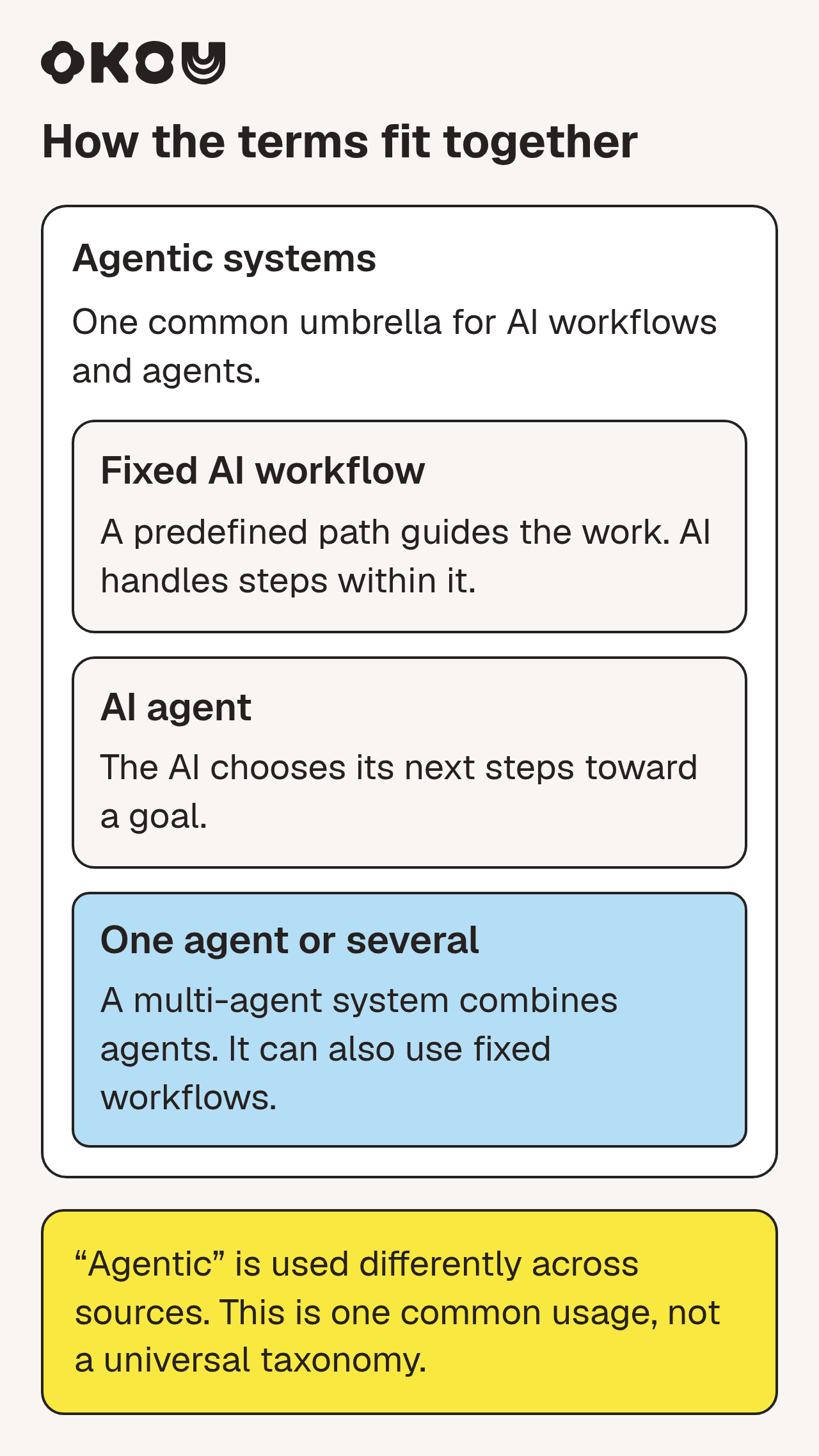
Figure 1. One common use of “agentic systems” as an umbrella for workflows and agents. Multi-agent describes how agents are combined; these are not mutually exclusive product categories.
The real question: who picks the steps?
All three uses share one idea. The more an AI decides for itself, the more agentic it is. Most business work falls into one of three levels:
- Assistant. You ask, it answers or drafts. You do everything else.
- Workflow. The steps are agreed in advance. The AI does the reading and writing inside each step.
- Agent. You give it a goal. It decides what to check, which tool to use, and when it has enough.
IBM's Maya Murad calls this a "sliding scale" of autonomy. You pick the level for each task. It is not a feature you buy once.
YouTube · IBM Technology
What are AI Agents? · July 15, 2024
Maya Murad walks through the "sliding scale" of AI autonomy, then explains why a narrow, predictable task often works better with a fixed path than with an agent.
Agent or automation? A debate worth knowing
People who build these systems for a living are arguing about this right now. Alex Vacca, who describes himself as founder and CEO of Frontal AI, a company that helps B2B firms grow revenue, put the case for automation bluntly in a recent post.
X · Alex Vacca (@itsalexvacca) · October 7, 2026
"If you can write every step down first, build an automation." … "An agent fails quietly."
His point is practical. If a job has fixed steps (our example: copying new form entries into a CRM), paying an AI to decide those steps is wasted money. He also notes that a broken automation usually throws an error, while an agent can keep reporting success as its answers slowly get worse. So he has a person approve before anything is sent.
We agree with the test, with one caution: it is one practitioner's view, based on his own setup, from someone who sells this kind of work. It matches what Anthropic and IBM say, though. Start with the simplest thing that works. Use an agent only when the steps really depend on what it finds.
Common myths
"Agentic AI is the newer, better version of AI agents." No. An agent is one of the most agentic things there is. The terms describe degrees, not product generations.
"More autonomy is always better." No. More autonomy costs more and is harder to check. For a weekly report with the same shape every time, a fixed workflow is cheaper and more predictable.
"An agent knows everything about your business." It only knows what it can see: the tools you connected and the conversation it is in. In Okou, for example, a chat keeps its own context. A new chat starts fresh unless you bring an earlier one in on purpose.
"More agents means more capable." Not necessarily. Every handoff between agents is another place for mistakes to pile up or for access to spread. Ask who owns the final result.
"The label tells you what it does." It doesn't. Gartner coined "agent washing" for exactly this, and it was still warning about it in 2026. Ignore the word and ask what the product does on its own.
One task, three ways: a campaign report
Imagine a marketing manager needs Friday's campaign summary. This is an illustrative task, not a customer result. The campaign tracker records sign-ups, the ad account records spend, and the brief defines the reporting period. One channel has not finished reporting.
1. Ask an agent once
The manager asks: "Compare spend and sign-ups for this week's campaigns. Use the dates in the brief, link the figures, and flag incomplete channels. Prepare a summary; do not change budgets or post it." The agent chooses the steps: read the brief, gather the figures, notice the gap and prepare a qualified comparison. Calling this an agent tells you who carries out the task, not whether the conclusion is correct.

A real activity indicator from a different task. It shows work in progress, not evidence that the campaign report has been checked or completed.
2. Save the reporting method as a workflow
Once the manager has checked the result, they save the source list, date rule, calculation and review checklist as an Okou workflow. The steps can be quite predictable while some work within a step still requires judgment, such as noticing that one channel uses a different date range. A workflow is a reusable method. It is not proof that several agents collaborated, and it is not a promise that the AI may make every decision alone.
3. Add a schedule separately
An automation can start that workflow every Friday for a named owner. It changes when the job starts. It does not supply missing data, make the report reliable or authorize a budget change.
The acceptance test is the same in all three versions: consistent dates, figures linked to sources, missing data labeled and a draft left for review. If the report recommends moving budget, the manager checks the evidence and decides. This is why the useful distinction is between the worker, the saved method and the trigger, rather than three increasingly impressive product labels.
What stays with people
Letting AI pick the steps should not mean nobody is responsible for the result. Before an agent touches real work, settle four things:
- What it can read. Which inboxes, CRMs, and documents, and through whose account.
- What it can change. Drafting is not sending. Suggesting a CRM update is not making it.
- Where it stops. Which actions always wait for a person.
- What it hands back. A brief, a draft, or a record someone can check against its sources.
People who use AI at work already think this way. In Microsoft's 2026 Work Trend Index, a survey of 20,000 AI users in 10 countries taken in early 2026, 86% said they treat AI output as a starting point, not a final answer. These are people's own answers, not a measure of results.
For more on how a team adjusts when AI starts taking on work, see what changes when AI operates autonomously.
Questions to ask any "agentic" tool
- Who picks the steps? Set in advance, chosen by the AI each time, or a mix?
- What can it see? Which tools, through whose login, and does it remember past conversations?
- What needs your approval? Is that enforced by permissions, or just written in a prompt?
- What does it do when it's unsure? Does it flag the problem, or guess?
- Can you see what it did? Is every step and result recorded?
- Can your team reuse what works? Can the method be saved, shared, and scheduled with a named owner?
A tool that answers these clearly is worth a look, whatever it calls itself. For ideas on where to start, see these AI agent examples for real work and our guide to managing context and permissions.
FAQ
Is agentic AI the same as an AI agent?
Not exactly. An AI agent is a specific system that takes a task, picks the steps, and uses tools to finish it. Agentic AI is the wider term for AI that works this way, to any degree. Every AI agent is agentic, but "agentic AI" can also mean a fixed workflow with AI steps, or several agents working together.
What is the difference between agentic AI and generative AI?
Generative AI writes or creates something when you ask, then waits. Agentic AI uses that ability to work toward a goal: it plans, takes actions with tools, checks the result, and keeps going. Most AI agents run on a generative model, but writing a reply is only one part of what they do.
What are the risks of agentic AI?
The risks come from acting, not answering. An AI with access to email, a CRM, or ad accounts can make a wrong change or send something nobody checked. Gartner's 2025 forecast that many agentic AI projects will be canceled by 2027 pointed to cost, unclear value, and weak risk controls. Give it only the access the task needs, keep a record of each step, and require approval for anything that leaves the company.
What is the difference between agentic AI and RPA?
RPA (robotic process automation) follows recorded steps exactly, like copying fields from one system to another. Agentic AI can handle work where the next step depends on what it reads, like an email that needs to be understood. Some RPA tools have been relabeled as "agentic" without real changes, so ask to see how a tool handles something unexpected.
Can agentic AI work fully autonomously?
Some systems can run many steps without a person. In business, that is rarely the goal. Most teams let the AI research, draft, and suggest, while a person approves anything external or hard to undo, like sending an email or changing a record. Analysts remain cautious too: in May 2026, Gartner said most supply chain planning tools had not reached full autonomy.
Do I need an AI agent or a simpler automation?
Start simple. If a task has the same steps every time, a saved workflow on a schedule is cheaper and more predictable. Use an agent when the steps depend on what it finds, like working out why an account is at risk. Many teams do both: use an agent to figure out the method, then save it as a workflow to repeat it.