To analyze YouTube comments for customer insights, start with a relevant video and one business question. Read the themes alongside the original comments, separate reactions from self-reported experience, and check what people are responding to in the video. Then turn the evidence into a small set of proposed actions—not a claim about what all customers want.
We tried this in Okou using James Hoffmann’s The Fellow Aiden Review. The product run returned a 182-comment sample, a report and a comment CSV. The first answer also made mistakes: it called self-reported users “actual owners” and overstated what their comments established. We challenged those claims before using the analysis.
You can inspect the case report and download the actual comment sample. The CSV contains original text beside Okou’s coding; the coding is a first pass to review, not verified customer data.
For example, self-reported morning routines can inform a setup-versus-daily-use demonstration. A quoted phone/app criticism can suggest an FAQ to fact-check. A proposed navigation fix belongs in product review, not a help article claiming the feature exists.
This is independent editorial research for a hypothetical coffee retailer, not work commissioned or approved by Fellow or the creator. We did not test the brewer.
1. Give Okou the video and your question
Choose a video that can inform a decision. A detailed review may surface evaluation questions and self-reported experience. A tutorial may reveal confusing instructions. An entertaining video may mostly tell you what viewers enjoyed watching.
Our opening prompt was two sentences:
What do people care about most in the comments on this video? I’m planning what a coffee retailer should explain to buyers: https://www.youtube.com/watch?v=lUFTOeT9fcE
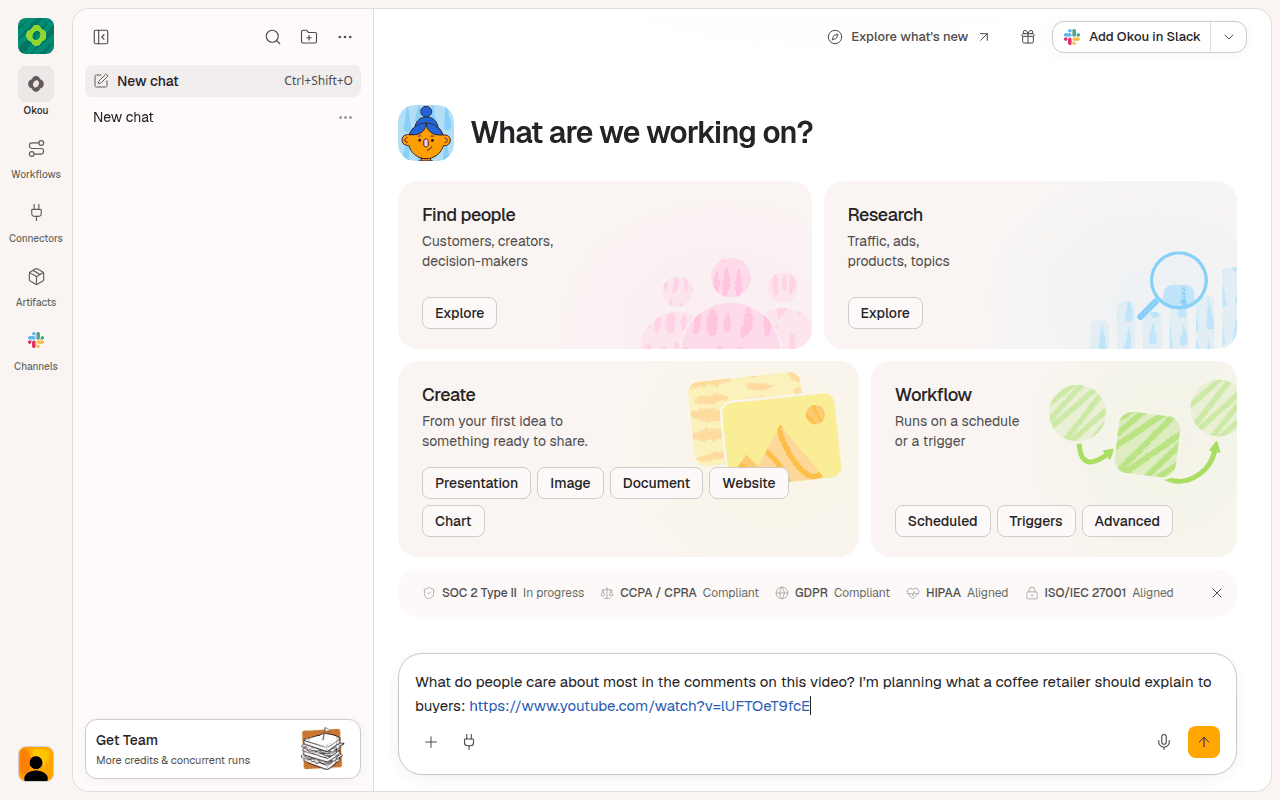
The actual opening request in our staging test. It supplies the video and business context, rather than a long specification.
That was the prompt actually submitted in a fresh product conversation. We did not run a longer instruction behind the scenes and replace it with this wording for the article. Subsequent corrections came through real follow-ups.
You can start with the YouTube comment analyzer. You don’t need to dictate a classification schema before seeing the conversation. You do need to check what was collected before accepting the conclusions.
2. Check the sample before interpreting the themes
In this run, Okou reported two pulls of 100 comments—one requesting top order and one requesting newest order. Its exported CSV contains 182 rows with distinct comment text and distinct report IDs after exact-text deduplication. We checked those counts in the downloaded file.
Here is the usable collection record:
- Video: The Fellow Aiden Review, James Hoffmann; video ID
lUFTOeT9fcE. - Collection date: November 23, 2026.
- Reported retrieval: 100 top-order rows plus 100 newest-order rows; 182 retained after deduplication. Requested ordering was not independently verified against the live YouTube interface.
- Exported fields: original text, author, displayed likes, displayed reply count, returned date, retrieval order and coding columns.
- Reply coverage: the CSV has reply counts, but no reply bodies tied to a parent comment. We did not analyze reply threads.
- Traceability: the CSV’s
comment_idvalues identify records in this report. They are not verified YouTube comment IDs or individual comment permalinks. - Date limitation: repetitive returned dates were not reliable enough to establish posting times. We made no time-series or before-and-after-firmware claim.
This is a bounded, non-random sample—not all comments and not 182 customers. Top sorting can foreground popular jokes. Newest sorting may surface different questions, but requesting it does not make dates or ordering trustworthy.
Keep the exported originals before cleaning. Exact-text deduplication can merge two genuinely identical comments; a repeated author can also write several distinct comments. Comment counts are not counts of distinct people.
For generic cleaning and grouping, our Instagram comments guide covers the move from repeated questions to FAQ drafts. The extra work on YouTube is checking what viewers are reacting to inside the video.
3. Separate reactions from self-reported experience
Use two labels: what the comment discusses and what kind of evidence it contains. “Controls” is a topic. “Reaction to the review” is an evidence type. A forceful opinion about the controls is not automatically a hands-on product test.
The first Okou answer blurred that distinction. It described “actual owners” and said their cup-quality praise was nearly unqualified. We did not accept that wording.
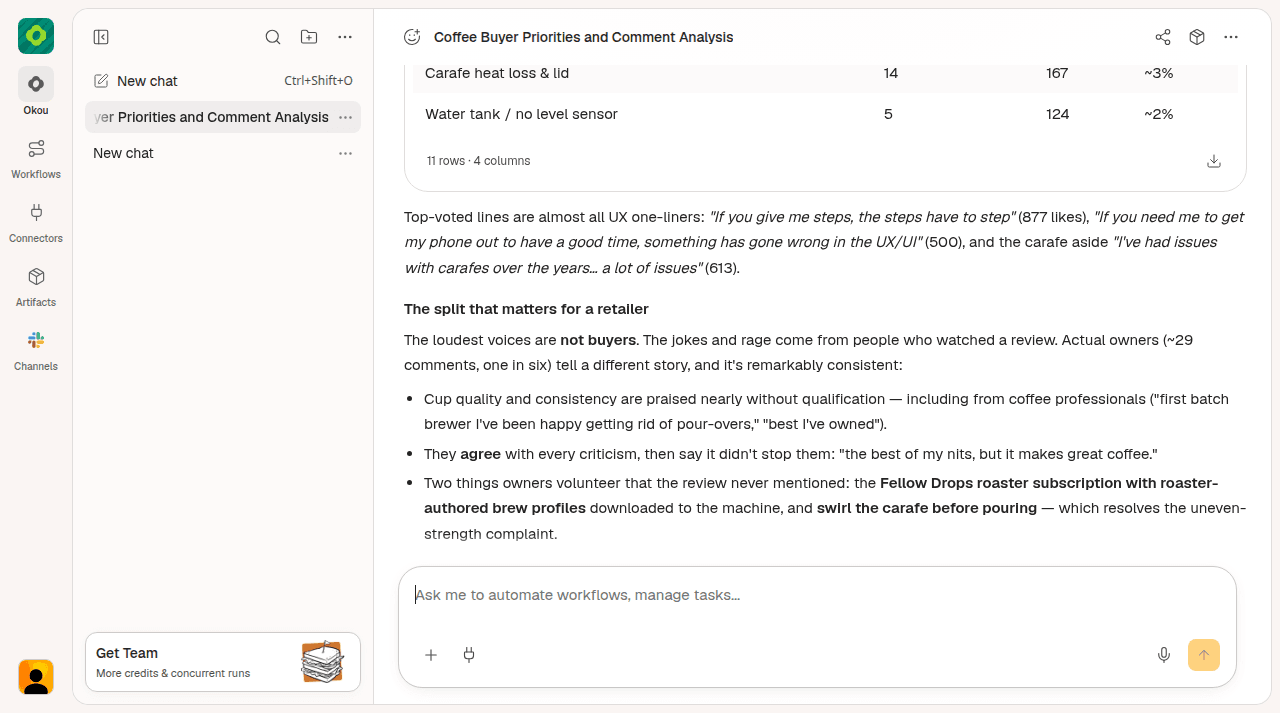
Initial answer, not an approved finding. “Actual owners” and the broad praise claim were reasons to ask for another pass.
Our actual follow-up was:
The comments don’t prove who bought it. Separate reactions from self-reported experience, and save the findings and next steps as a Markdown report with a CSV of the original comments.
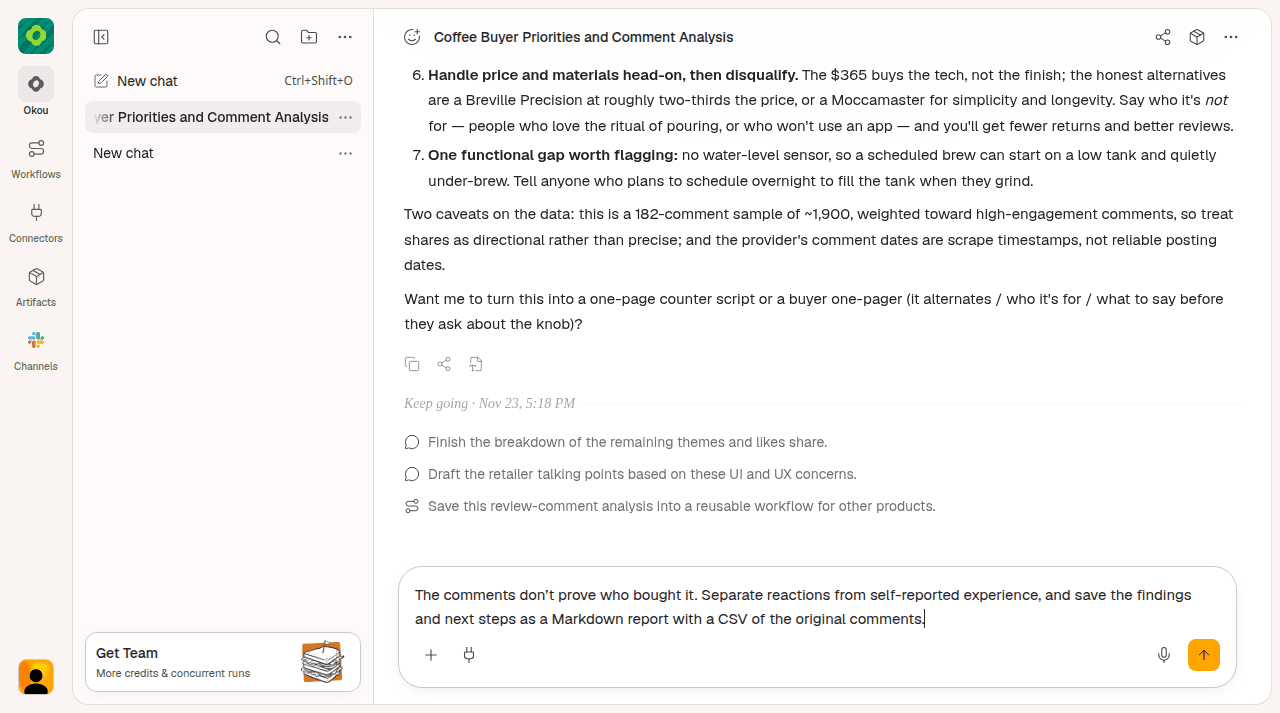
This correction was submitted in the same real conversation. The report and CSV were created after it—not inferred from the opening prompt alone.
Okou’s revised coding labeled 126 comments as reactions and 34 as self-reported Aiden use. Those are counts under its coding scheme, which we verified against the CSV—not an independently validated measure of customer status or satisfaction. The recode also included negative self-reported experiences that the first summary had glossed over.
Here are several source-level checks that matter more than a sentiment score. Numbers refer to the CSV’s comment_id column.
Comments 5 and 11: a routine worth demonstrating
5, @IamFilter94:
“Before I got Aiden, I brewed average, inconsistent V60 cups using the same recipe.”
11, @jokimoto808:
“the consistency in performance (especially at 5am before my morning workout) is a luxury I’ve never been able to really enjoy.”
Both describe personal experience. Neither establishes typical performance, measured time savings or verified ownership.
Proposed action: demonstrate what someone sets up once versus what they do each morning. Check the actual product steps before filming; do not promise that everyone will get the same results.
Comment 1: an interface reaction, not a verified usability test
1, @Jamiemlux:
“UX Designer here. The rage that this has brought me is palpable. That screen and wheel combo is the thing of nightmares.”
The comment does not say the person used the machine. Their professional identity is self-described too.
Proposed action: inspect the workflow shown in the review and look for supporting firsthand accounts before presenting this as a product defect. A clear controls demonstration may be useful, but the comment alone cannot validate it.
Comment 23: a proposed fix is not a shipped feature
23, @scorch855:
“There is a simple fix for the back button issue that doesn't require changing the input method. Push to select, push and hold to go back.”
This proposes an interaction. It does not establish that push-and-hold works on the product.
Proposed action: route back-navigation friction for review. Do not turn the comment into a help instruction.
Comment 13: an engaged viewer who isn’t shopping
13, @internetshaquille:
“Fascinating review, even though I’m nowhere near the market for this product”
Keep this comment in the analysis. It directly contradicts the shortcut from “engaged audience” to “potential buyers.” Comment 10’s affordability remark is another reason not to equate watching with purchase intent.
4. Check quotations against the video
Viewers often repeat a memorable line. Without context, repetition can look like independent corroboration.
8, @Andrea-wx3hq, writes:
“If you give me steps, the steps have to step”
The retrieved transcript places the presenter’s similar line at 10:00, during discussion of the control wheel. Treat this as an echo of that moment, not another hardware test.
22, @jevidon, quotes the objection to needing a phone and compares it with another appliance. The review passage begins around 10:59. This supports investigating an on-device-versus-app question; it does not establish that the commenter owns Aiden.
These timestamps come from the transcript, not comment permalinks. Read the surrounding passage, using a video transcript if helpful. If a conclusion depends on something visual, watch the footage before making a product claim. We checked transcript context, not the physical machine or its current firmware.
Likes add another trap. They indicate displayed engagement with a comment, not why someone liked it, whether they bought anything, or which product feature matters most to customers. A popular line can simply be funny.
5. Ask for a report you can review, not just persuasive advice
The first saved report still went too far. It included untested brewing guidance and a timeline inference despite admitting unreliable dates. Our next actual follow-up was:
The report still treats suggestions as proven advice, and its timeline claim contradicts the unreliable dates. Please fix those, connect each action to the source comments, and give me a report page I can open and share.
A further source audit caught mismatched citations: comments 11 and 57 did not mention Fellow Drops, and comment 134 described switching away from Aiden, not replacing another brewer with it. We pointed those out in another real follow-up. The exact prompts and earlier outputs are retained in the review evidence, rather than silently presented as a flawless first answer.
The resulting report page distinguishes observations about this sample from hypotheses about buyers. Read it beside the CSV; source identifiers are only useful if they lead to the right words.
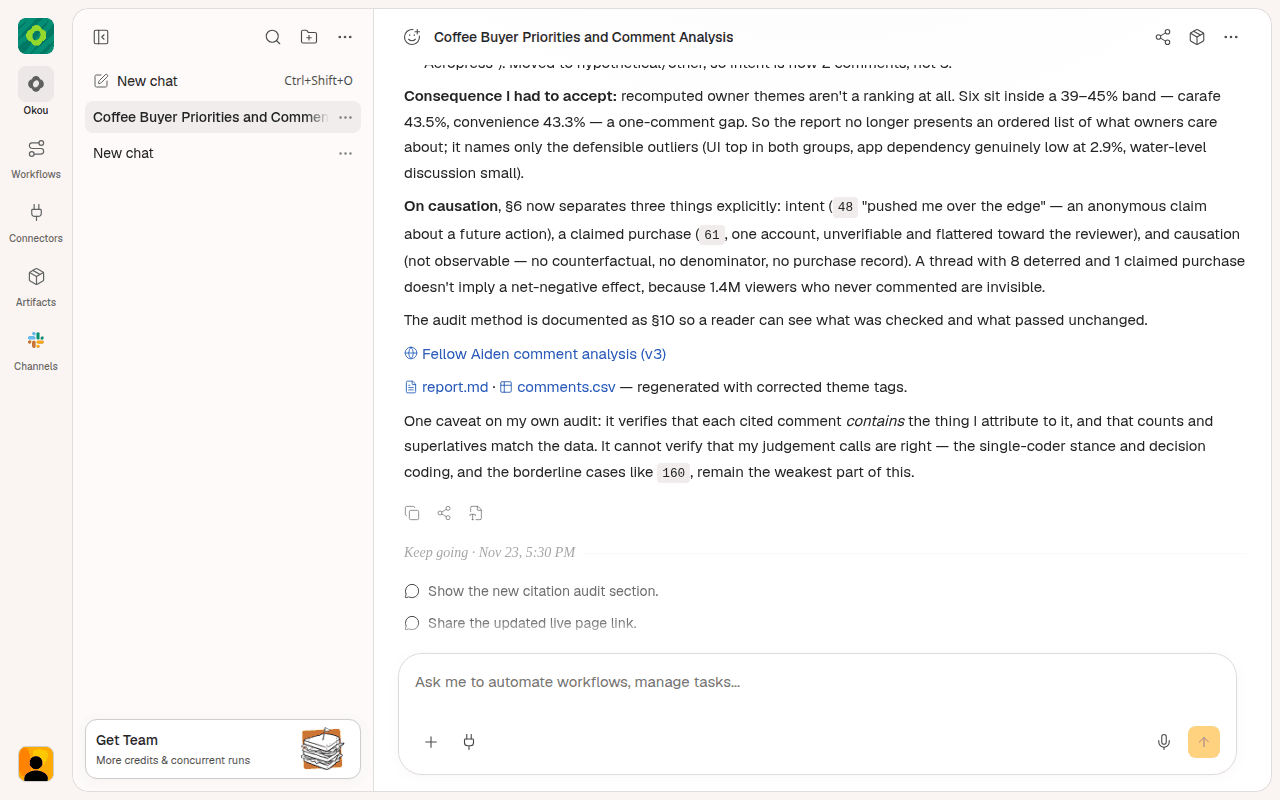
Final delivery in the actual staging conversation. We opened the report page, downloaded the revised CSV, and checked the original comments used in this tutorial.
For a team using this research, a small review queue could look like this:
FAQ: “What can I do without my phone?”
Source: comment 22 and review context at 10:59. Draft a plain-language on-device/app comparison. Product support must confirm current functionality before anyone publishes the answer.
Video: “Set up once, brew in the morning”
Source: comments 5 and 11. Show initial setup separately from daily use. Verify every step; make no generalized time-saving or quality promise.
Product-review note: back navigation
Source: comment 23. Preserve the suggestion and described friction. Check existing behavior and do not promise a fix.
Support investigation
Source: comments 133 and 173. Investigate reported flow-meter and water-related failures with support or the distributor. Treat them as unverified reports, not established defects.
These are editorial proposals, not explicit viewer requests or completed business actions. Product marketing could own the FAQ and video brief; support or the product team should check functionality and failure reports. No reply was posted and no commenter was contacted in this case.
6. Audit before sharing the recommendations
Open the exported sample and find every comment used in an action. Compare the exact text with the interpretation. For this example, the consequential checks were:
- 5 and 11: self-reported routines, not evidence of typical results.
- 8: repeats the presenter, not independent defect corroboration.
- 23: proposes an interaction, not proof it exists.
- 13: explicitly not shopping.
- 134: switched away from Aiden; reversing that direction changes the finding.
- Dates: not reliable posting times, so no historical trend claim.
Treat the coding columns as editable analyst judgments. For example, comment 10 says the viewer cannot afford the machine; it does not by itself establish the same “not shopping” position as comment 13. Keyword tags and purchase-language categories need source-level review too.
Keep important product claims out of customer-facing advice until current documentation or a suitable test supports them. If you test a content idea later, define the audience, metric and comparison separately. A comment-inspired hypothesis is not evidence of a conversion lift, and a product-page test would not turn the original sample into a customer survey.
The right finish is a reviewable decision: an FAQ to fact-check, a demonstration to brief, or a specific report to investigate. It is not a sentiment score dressed up as a sales forecast.
FAQ: YouTube Comment Analysis
Can YouTube comments tell me what customers want?
They can reveal possible needs, questions and language to investigate. Commenters may be users, prospective buyers, fans or people who are not shopping. Confirm consequential findings with suitable first-party evidence before calling them customer-wide priorities.
Should I use top comments or newest comments?
They answer different questions. Top sorting can surface visible discussion; newer comments may reveal recent questions if the returned dates and order are trustworthy. Preserve each pull separately, record what was actually returned, and check overlap before combining them. Neither is a representative survey.
Is sentiment analysis enough?
No. A negative comment may criticize the review, price, interface or an unrelated product. A positive one may praise the presenter. Keep the topic and evidence type alongside sentiment. Neither sentiment nor likes establish sales or willingness to pay.
Can I analyze a video I don’t own?
Public comments can support bounded research when your tools can retrieve them. That does not grant private audience analytics, hidden comments, verified customer identities or permission to speak for the creator. In this case, we analyzed public material and left all proposed actions as drafts.
How can I turn YouTube comments into content ideas?
Link each idea to specific source comments. Separate self-reported routines from verified outcomes, and topic questions from purchase intent. Use these distinctions to draft an FAQ, a demonstration brief or a support investigation plan. A human must verify product functionality and approve actions. Neither this sample nor likes prove conversion lift; all proposed actions in this case remain drafts.
Start with one video and one decision
Give the YouTube comment analyzer a relevant link and a normal question. Let the first answer show you what needs clarification. Then ask short follow-ups, inspect the source comments, and keep the difference between an observation and a proposed action visible.