You've made an account and nothing is connected yet. That's the right place to be.
The first step takes about five minutes and needs no setup at all. The five after it build up to something your whole team can use. Stop wherever it's already useful — plenty of people never go past step 2.
If you already use Claude Code or Codex daily, start at For Claude Code and Codex users instead, then come back here for steps 3 to 6.
1. Send a few prompts
Open a new chat from the sidebar. Don't overthink it — Okou handles plain language, and there's no syntax to learn. These four need nothing connected, so they work on a brand-new account:
"Brief me on [Company] before my 3 p.m. — what they do, recent news, and anything I should avoid saying."
"Turn these rough notes into a clear update for my team: [paste notes]."
"Draft a polite follow-up to someone who hasn't replied in a week. Friendly, three sentences, no pressure."
"Make a 5-slide deck explaining our pricing to a non-technical buyer."
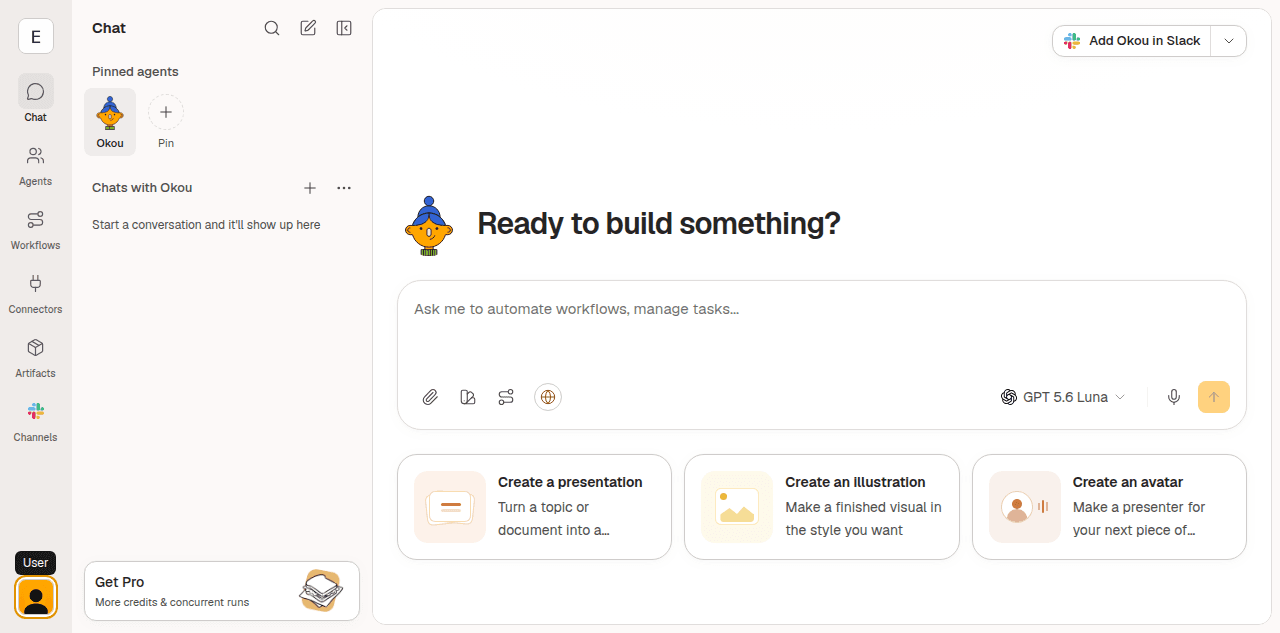
You'll see Okou's plan, the tools it picks, and a live record of every step it takes.
Now try one that reaches into a real account of yours — "Summarize my unread Slack messages and tell me what needs a reply today." Okou will stop and tell you it has no access to Slack yet. That's not an error; it's the handover into step 2.
Two habits are worth forming in this first chat, because you'll use them constantly:
- Correct it in place. Reply with a fix — "Same, but leave out the marketing channel," or "Two sentences shorter, and end with a clear ask." You're adjusting the work in progress, not starting over.
- Read what it did. Under the result is a record of everything Okou looked at and everything it changed. When the answer comes out wrong, that record usually shows you which single step to correct — faster than rewriting the whole request.
2. Try a workflow template, and connect the tool it needs
Writing procedures from scratch is the slow way to start. Okou ships a catalogue of ready-to-run workflow templates. Open the Template button in the chat composer and choose the Workflow category, then filter by the kind of work you do — Sales, Marketing, Support, Operations, Product, Data, Engineering, or CEO.
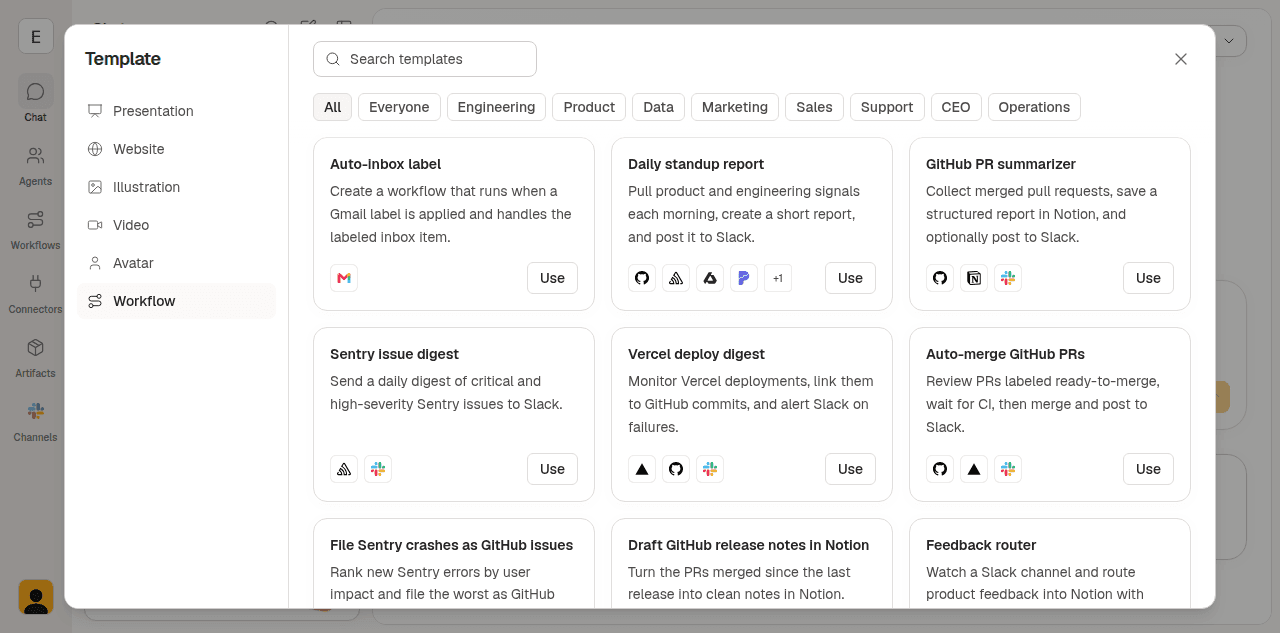
Every card says what it does and shows which services it touches, so you know what it needs before you commit:
- Highlight key emails in Gmail — surface the messages that actually need you
- Prep for Google Calendar meetings — a short brief before every external meeting
- Get meeting recaps in Slack — decisions and action items shared after the call
- Catch leads from Gmail — spot buying signals and log the qualified ones
- File Gmail invoices to Google Drive — file invoice emails and log them as they arrive
Choose Use on one that touches a tool you already work in. Okou will need your permission for that tool, and will stop and ask:
- Tap Connectors in the chat composer and choose Add connectors, or just follow Okou's prompt in the conversation.
- Search for the service and add it.
- Sign in to that service in the popup, the same way you'd sign in anywhere else.
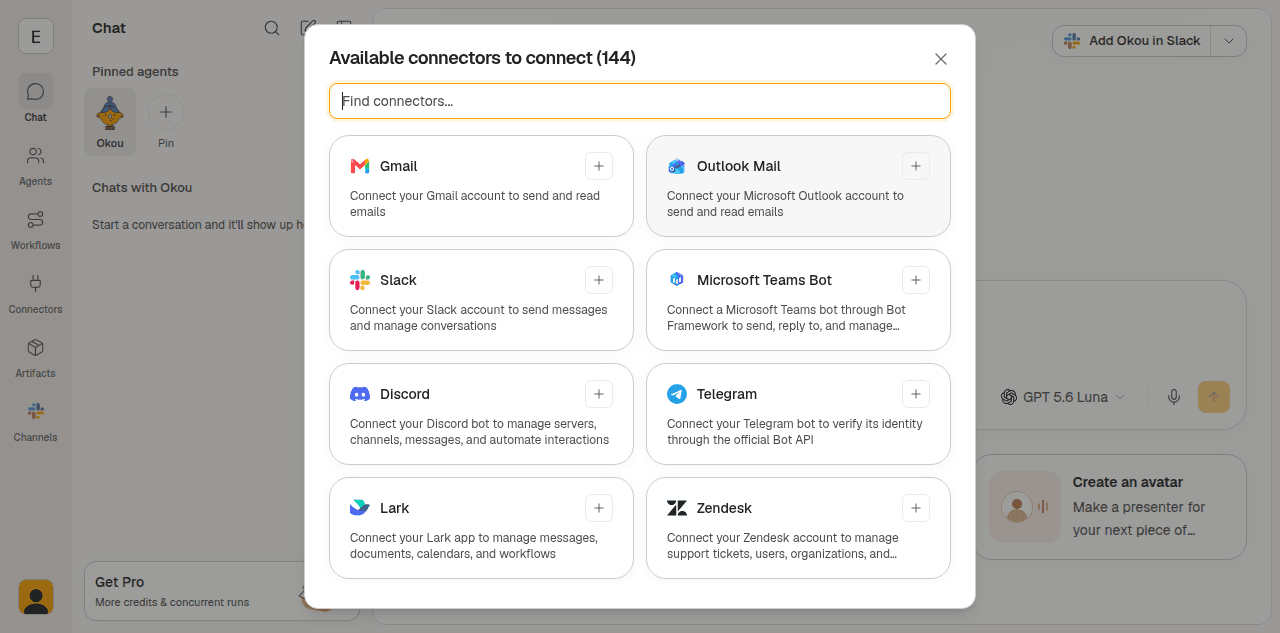
If Okou asked for the connection mid-task, it picks up where it left off as soon as you're done. If you added it from the Connectors page instead, Okou asks which agents are allowed to use it. One connection can serve several agents, but each agent only gets the specific permissions it asks for — and some access is granted for a limited time and has to be renewed.
Popular places to start: Gmail and Google Calendar for your inbox and schedule, Slack for team conversation, Google Drive, Google Sheets or Notion for documents, HubSpot for customers.
You don't have to authorize everything up front. Connect what the work needs, when it needs it. The Connectors page inside your workspace is the authoritative list of what's available to you — see the connector catalog for a grouped index of the most-used ones.
Okou never sees your passwords — they stay on the platform, and are never handed to the AI model. Every time Okou touches one of your tools it shows up in the record: which account, what it read, what it changed, when. You can disconnect a service or narrow what it's allowed to do at any time. See Permissions for the full security model.
3. Make your own agent and shape it
A template teaches you the shape of the work. An agent is where you make it yours.
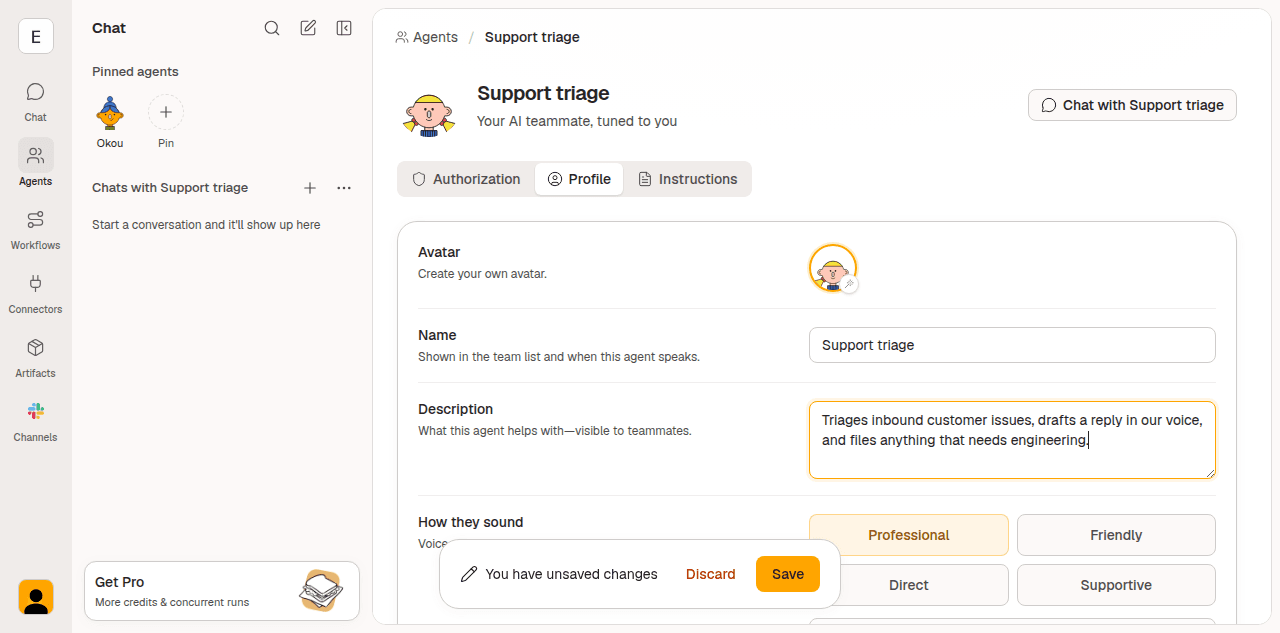
An agent is a persistent teammate: its own instructions, its own tone, its own access, its own saved procedures. Open Agents → New agent and create one for a job you care about — support, research, marketing, recruiting. The dialog defaults to Public; switch it to Private while you're still getting it wrong.
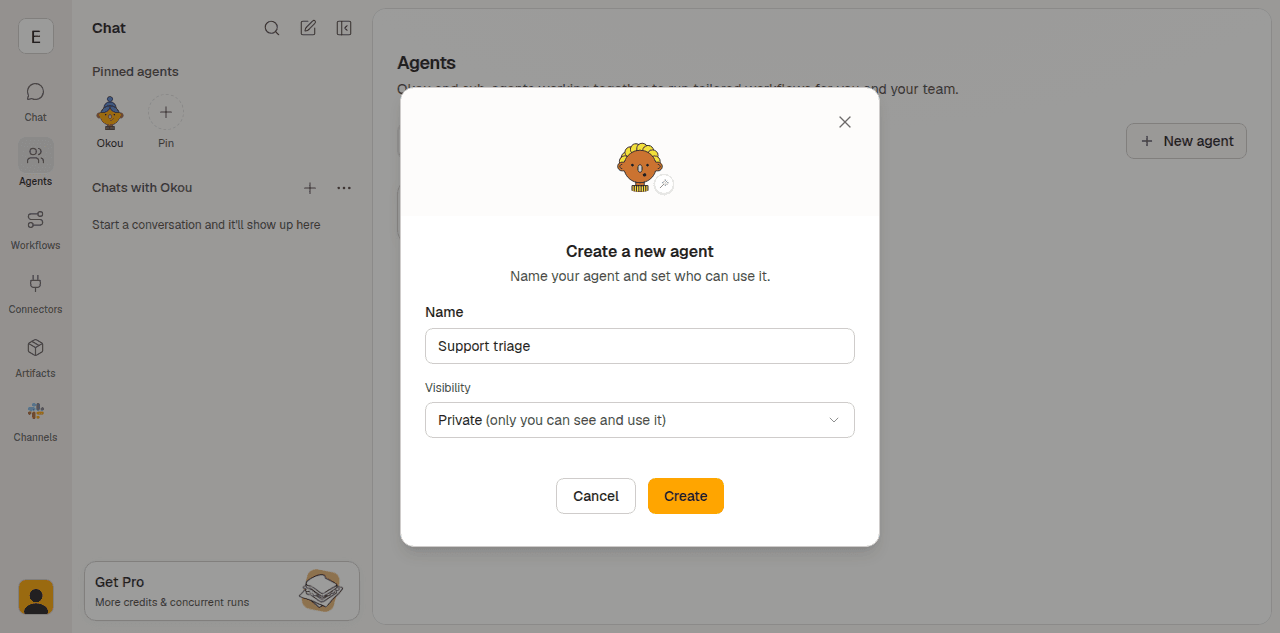
The agent's own page is where you shape it. Profile holds its name, the description teammates see, and the voice it replies in. Instructions shows the standing directions it currently follows. Authorization controls which of your tools it can reach.
Then tune it the way you'd bring on a new hire:
- Give it a real task.
- Where the result is off, say so in the chat, then ask Okou to remember it: "From now on, always cite the source document, and never send an email without showing me the draft first."
- Try again. Repeat until its default behaviour is the behaviour you want.
Good standing instructions cover the audience, the tone, the shape of the output, which tools to prefer, and the limits — what it must never do, and when it should stop and ask you. That last part matters more than it sounds: it's how you decide what your agent is allowed to do while you're not watching.
Resist the urge to write the perfect instructions before the first task. They get good by being corrected against real work, not by being drafted carefully in advance.
4. Save what worked as a workflow
In step 2 you borrowed someone else's procedure. This is where you capture your own.
The moment to do it is when you've asked for the same thing twice and tweaked it the same way both times. Ask, in that same conversation: "Turn this into a reusable workflow called morning brief."
Staying in the conversation matters — it gives Okou the real inputs, your corrections, and the output you actually accepted.
Okou reads the conversation, drafts the procedure, and saves it for you — you never leave the chat. It proposes a name, a description, the instructions, any attached files, and who can see it. Review all five, and pay particular attention to two:
- The description is what decides when this workflow gets used later. "Draft a reply to a customer email using our voice and our help docs" will be picked up on the right message; "do email stuff" never will.
- Who can see it. New workflows are private to you. Sharing one with the workspace is a deliberate step, not something that happens automatically when you save. (Agents are the other way round — those default to public — so check both.)
Afterwards the workflow gets its own page under Workflows. That's where you go later to check or change it, not somewhere you had to go to create it. Instructions is the procedure Okou follows every time; read it back once, because this is what you'll edit when the results start to drift. The short name under the title is what you type to call it up directly in a chat.
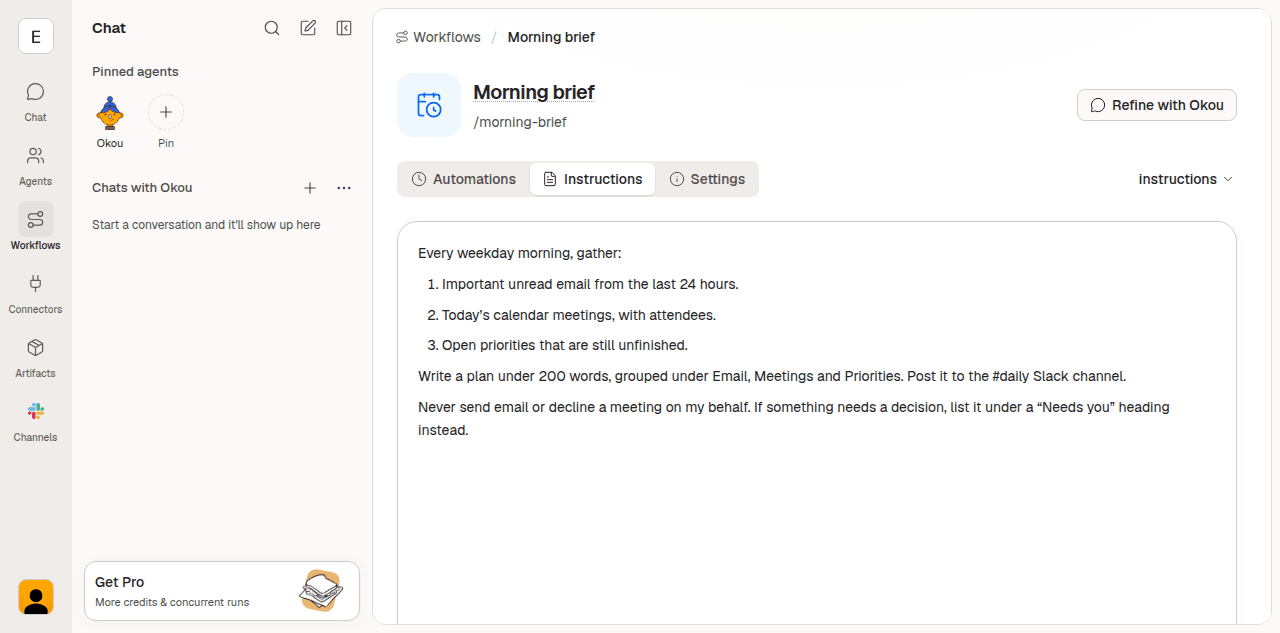
A workflow belongs to one agent, and runs with that agent's tone and access. See Workflows for the full picture.
5. Give it a schedule
Now make it run without you:
"Run this every weekday at 8 a.m. and send me the result in Slack."
Again you never leave the chat: Okou confirms the timing and where the result should land, sets it up, and the task starts running on its own. Name a destination it can actually reach — if the result should arrive in Slack or by email, that service needs to be connected first. If you'd rather set it by hand, the same thing lives on the workflow's Automations tab under Add automation.
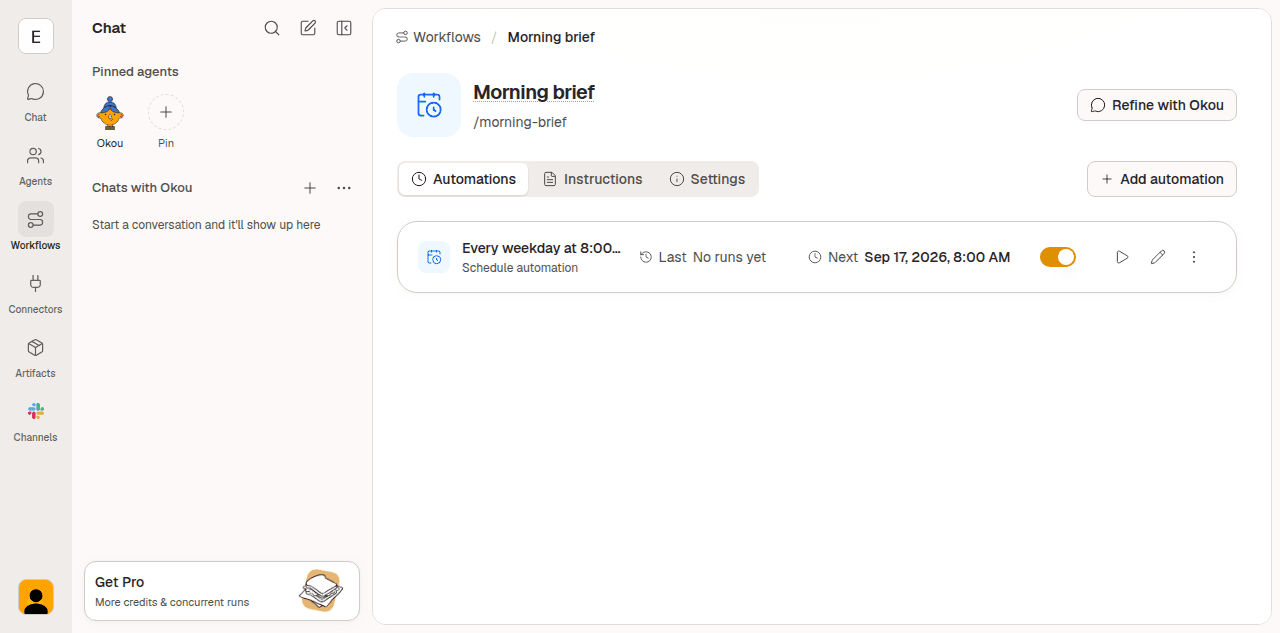
Each one shows when it last ran, when it runs next, and a switch to pause it without deleting it. The ▷ button runs the workflow immediately.
A clock is only one way to start a workflow. It can also wait for something to happen — a new email arrives, a meeting is booked, a form comes in, a document changes. See Automations.
One rule worth keeping: run it by hand before you let it run on its own. If the ▷ button fails, the problem is the workflow or its access. If ▷ works but the schedule never produces anything, the problem is the timing setup. Chasing both at once is how a ten-minute setup turns into an afternoon.
Start small, too. A daily or weekly run you check over the first few days beats an hourly one you have to untangle later.
6. Invite your team, and use it together
Invite people once there's something for them to walk into. An empty workspace is a worse welcome than one good workflow with their name on it.
Before sending invitations:
- Switch the agent they need from Private to Public.
- Share the workflow you want them to run first.
- Take any passwords, keys, or one-off personal details out of its instructions and files.
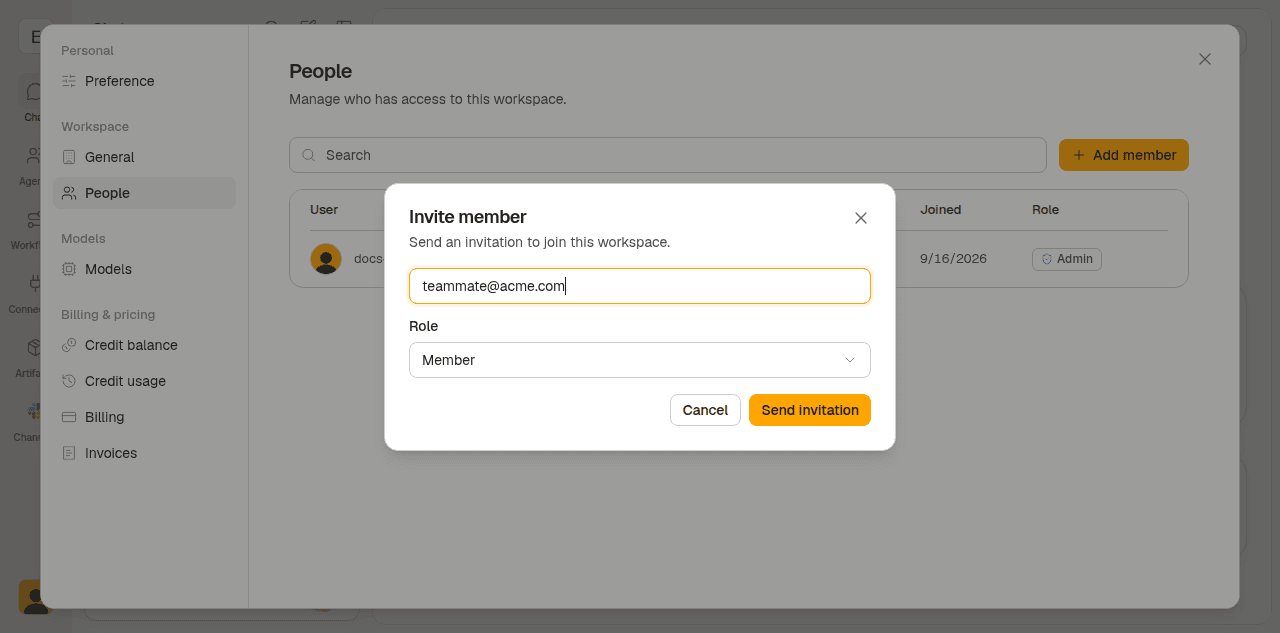
- Decide who needs Admin and who only needs Member. Use Member by default — Admin is for the people who manage membership, billing, and workspace settings.
Then open Settings → People → Add member, enter the email address, choose the role, and send. The invitation stays pending until it's accepted, and you can review or cancel it from the same page. See Invite teammates.
Once they're in, the difference between a personal productivity tip and something the team relies on comes down to a few habits:
- Hand over the first task explicitly. Tell a new member what to run, what to give it, and where the result will show up.
- Everyone keeps their own accounts. Each person connects their own Gmail, their own Slack. Nobody shares a login.
- Share what works, keep the rest private. Personal experiments stay private; the procedure the team depends on gets shared and looked after like any other shared document.
- Put it where the work already happens. Add Okou to Slack and the same agent answers in a channel. See Slack.
- Copy, don't rebuild. To give another agent the same procedure, copy the workflow. The two can then go their own way on purpose.
See For teams for what this looks like once it's running.
What to try next
Prompts that show the range — pick any that match your day:
- "Go through this week's customer emails, group the complaints by theme, and tell me the top three."
- "Read this customer email [paste] and draft a reply in Korean. Point to the help article that applies."
- "Pull last week's signups from our analytics, compare to the week before, and write me one paragraph I can send to the team."
- "Make a 5-slide deck about our pricing using the standard brand template."
- "Write four social posts announcing our new Slack integration, and make matching square images in our brand colours."
- "Before Thursday's renewal call, pull everything we know about this account and list the three risks I should be ready for."
Where to go next
- Workflows — capture a procedure once, reuse it forever.
- Automations — run work on a schedule, or when something happens.
- Agents — instructions, tone, and what each agent is allowed to touch.
- Connector catalog — a grouped index of the tools Okou can reach.
- Models — which AI model answers your chat, and what it costs to run.

